Just three percent of Black households own commercial real estate, making it more difficult for Black entrepreneurs to establish businesses and build wealth.


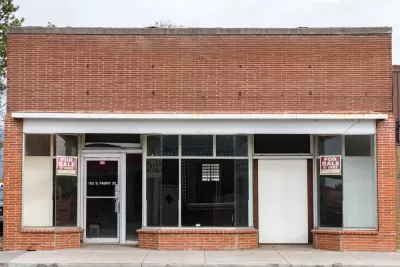
According to an article by Tracy Loh and Andre Perry in Bloomberg CityLab, the racial gap in property ownership is just as stark in commercial real estate as in homeownership. “Only 3% of Black households own commercial real estate, compared with 8% of white households, and their holdings are much smaller — valued at just $3,600 on average, compared with nearly $34,000 for white households,” according to a Brookings report.
This matters because “Nonresidential commercial real estate generated $512 billion in revenue in 2020. What’s more, racial disparities in commercial property ownership impede Black entrepreneurship, since most Americans who start businesses use their personal wealth — chiefly the equity tied up in property.” As the article explains, “This disparity leaves Black Americans with less capacity to establish and grow their firms — and their wealth.”
The authors also note that property in Black neighborhoods is often undervalued, putting owners in those areas at a disadvantage. “ This costs commercial property owners some $171 billion in aggregate wealth,” according to the Brookings analysis.
“The way to end this cycle is to diversify the owners of commercial real estate as well as change the rules that guide investment.” The authors point to Chicago-based TREND, a social enterprise dedicated to changing the landscape of commercial property ownership by facilitating more equitable ownership models. In one example, TREND invited local residents to become co-investors in a 47,000 square foot shopping center for as little as $1,000. “This innovative ownership model creates wealth for investors and provides opportunities for Black entrepreneurs and community residents to work on the property.”
FULL STORY: Commercial Real Estate Has an Equity Problem

Five Ways to Break the Cycle of Extractive Real Estate
Here are the steps to having economies operated by stewardship, not speculation.
Detroit Says Problems With Property Tax Assessments are Fixed. Advocates Disagree.
With higher-valued properties under assessed and lower-valued properties over assessed, advocates say there's still a problem with Detroit's property tax system.
Richmond Program Promotes Black Homeownership
Economic Mobility and Black Homeownership Pilot identified barriers to homeownership and provides homebuyers with down payment assistance and counseling.

The state-sanctioned urbicide of Austin
People don’t kill cities. Freeways do.

US to reduce Colorado River water deliveries to Mexico
A new Colorado Treaty amendment reduces Mexico’s Colorado River water allocation by 250,000 acre feet.

New Jersey’s second-largest city bans standalone data centers
Jersey City will continue to allow co-location facilities, such as those meant for research institutions that store their own data.

Amtrak not solely to blame for New Jersey commuter rail's unreliability, report finds
A new study from the Garden State Initiative found that NJ Transit’s budget grew 20% across a 4 year period, but reliability declined significantly over the same period.

EPA erases limits on planet-warming pollution from power plants
Under Monday’s plan, power plants would still have some limits on how much mercury, arsenic and other contaminants they can emit.

Phoenix announces new on-demand transit service, more frequent RAPID buses
Both new services will launch in October, and are part of Phoenix's Project Effective Access Solutions for Easing Congestion.

FREE Course: Walkable City 1: Why Walkability?
After describing his path towards focusing on walkability as the essence of good planning, Jeff Speck marches through his five principal reasons for making more walkable places.
Reinventing Malls: Planning Alchemy—Turning Gray Fields Into Gold
The course focuses on the opportunities and imperatives that shape reinvention of mall sites.

Eagle County Government
Harvard University Graduate School of Design
Nashville Planning Department
The Architects Foundation
University of Cincinnati Online
The Pocatello Development Authority
The Urban Renewal Agency of the City of Pocatello
Journal of the American Planning Association