According to one author, urban ghost stories are one way humans fight the alienation of modern life.


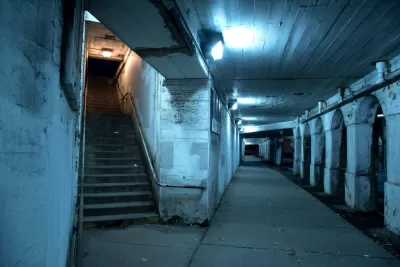
“Most metropolises are overrun with ghosts,” asserts Azania Imtiaz Khatri-Patel in a piece on Aeon. But Khatri-Patel isn’t just referring to the unfortunate souls that populate urban legends. Rather, “Our lives in cities are shaped by invisible hands, body-less voices and an eerie automation of infrastructure.”
For Khatri-Patel, “The automation of cities has the effect of alienating people from a state of personhood. It’s as if there is a tacit shadow-self that urban life produces.” Khatri-Patel recounts the anecdote of the woman whose deceased husband recorded some of London’s famous “mind the gap" announcements. After the transit agency switched the announcements to automated voices in 2012, Margaret McCollum’s story made national news, striking a chord with the public and prompting Transport for London to restore the original recordings at the station nearest to McCollum.
The article gives a wide range of examples of how the tension between tradition and modernity, between established customs and industrialization, between humans and automation, creates a need for urban ghost stories and legends about the abandoned spaces and mysterious nooks of modern cities. As Khatri-Patel points out, “Utilitarian approaches to urban planning do not leave room for emptiness. Spaces that fall into disuse for one purpose are quickly repurposed for another.” When spaces do stay vacant, they take on an eerie atmosphere, lending themselves to shadowy entities both literal and metaphorical.
“Yet there is a potent reconciliatory power to memory and ghosts. As we mark ghosts, we return their personhood,” Khatri-Patel concludes. Acknowledging urban ghosts means understanding the layers of history and meaning that accumulate as cities and society continuously evolve.
Read the full story: Ghosts haunt cities, seeking revenge for the disappeared past

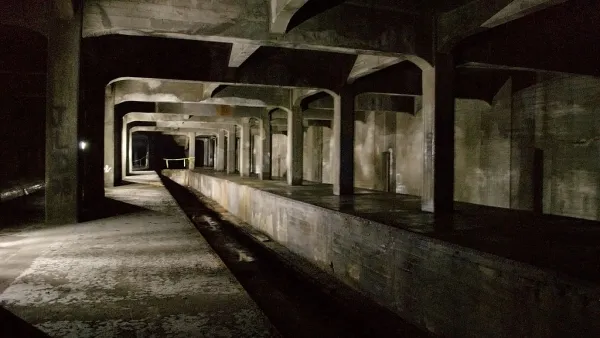
Cincinnati Seeks to Repurpose Its Unused Subway Tunnel
City officials are looking for proposals to use Cincinnati's long-abandoned subway tunnels, but not for transit; they already tried that.
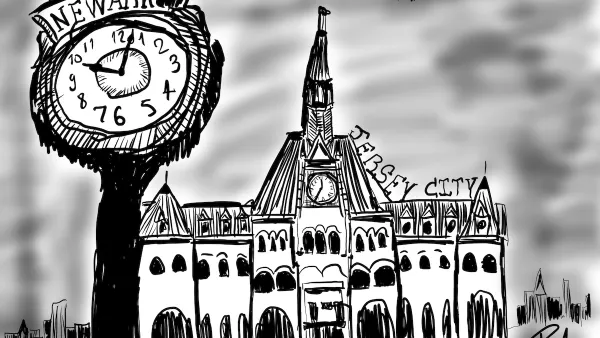
Jersey City and Newark: A Tale of Renaissance and Stagnation
The rise and fall (and rise again) of two great American cities teach us lessons about racism, economic opportunity, and more.

The Mystique of the 13th Floor: Superstitions, Sustainability, and the Future of Electrical Building Design
How engineers adapt a common superstition to maximize the utility of a stigmatized space.

Planetizen Federal Action Tracker
A weekly monitor of how Trump’s orders and actions are impacting planners and planning in America.

The state-sanctioned urbicide of Austin
People don’t kill cities. Freeways do.

Colorado’s Largest Data Center Could Rise Next to Homes — Without a Public Hearing
The proposed campus would consume 11 times the power of Denver International Airport; as it has across the country, opposition mounts.

Judges permit Denver to divert 77,000 acre feet from the Colorado River for reservoir expansion
Overuse and climate change have caused the Colorado River’s water levels to plummet.

Amtrak, CN end decades-long dispute with eight-year agreement
The new operating agreement establishes an updated framework for the companies to work together, including processes to resolve disputes.
Raised interest rates may kill financially vulnerable construction projects
The chief economist at ConstructConnect warns that if construction project owners are negatively impacted by the raised rates, it could result in delayed payments to contractors.

FREE Course: Walkable City 1: Why Walkability?
After describing his path towards focusing on walkability as the essence of good planning, Jeff Speck marches through his five principal reasons for making more walkable places.
Reinventing Malls: Planning Alchemy—Turning Gray Fields Into Gold
The course focuses on the opportunities and imperatives that shape reinvention of mall sites.

KFH Group Inc.
Greater Baltimore Committee
Eagle County Government
The Architects Foundation
University of Cincinnati Online
The Pocatello Development Authority
The Urban Renewal Agency of the City of Pocatello