People with disabilities often die at higher rates during natural disasters or other emergencies. One Oregon advocacy group wants to change that.


A new advocacy group in Oregon’s Marion County wants to promote more inclusive emergency management that takes into account the needs of people with disabilities. The group, led by 17-year-old Riley Hurt, “will connect the local disability community with emergency management professionals to improve outcomes for disabled folks affected by disasters,” according to an article by Marianne Dhenin in Next City.
“Disabled people are two to four times more likely to die or sustain critical injuries during a disaster than non-disabled people. A combination of factors leads to this condemnable statistic, including poor planning and barriers to accessing emergency information or services.” As Dhenin points out, “Ultimately, the systems meant to serve people during emergencies are not designed with disabled people in mind, and disabled people are often excluded from shaping these systems because their expertise is stigmatized or dismissed. The spaces where emergency systems are designed, like elected government and the healthcare, technology, and engineering industries, are also inaccessible.”
Advocacy groups like Hurt’s can help bridge the gap. “Across the country, the need for more inclusive emergency management grows more evident every time a climate catastrophe hits. During the record-breaking heatwave in Portland, Oregon, last June, some of the first Portlanders to die from hyperthermia were disabled adults living in low-income neighborhoods. When Hurricane Ida made landfall in Louisiana last August, disabled residents struggled to access support for evacuation.”
Hurt hopes the Marion County group will grow and serve as a model for bridging disaster management and disability advocacy.
Read the full story: In One Oregon City, the Disability Community Is Ensuring They Aren’t Left Out of Disaster Planning
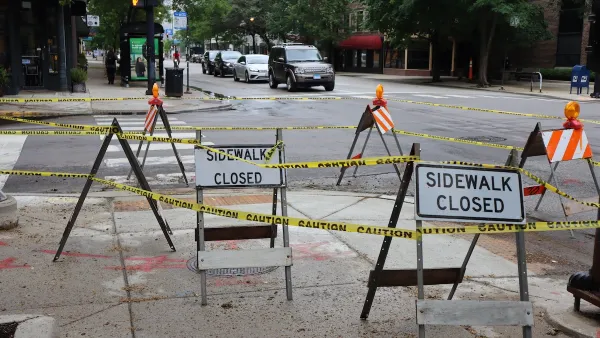
Chicago Residents Sue City Over Inaccessible Sidewalks
The suit alleges the city has failed to create a “coordinated, proactive system” for complying with ADA and ensuring accessibility on the city’s sidewalks and crosswalks.
Knoxville Ranked Best US City for People With Disabilities
An analysis of accessibility, affordability, healthcare access, and other metrics reveals the most disability-friendly U.S. cities.

Making Shared Micromobility More Inclusive
Cities and shared mobility system operators can do more to include people with disabilities in planning and operations, per a new report.

Planetizen Federal Action Tracker
A weekly monitor of how Trump’s orders and actions are impacting planners and planning in America.

California plans to bury El Niño’s downpour
If the state plays its cards right, it may be able to store a billion acre-feet of El Niño’s water in aquifers.

Desperate measures: Advocates weigh draining Lake Powell to fill Colorado River
Draining the reservoir could reduce evaporation losses by a couple hundred thousand acre-feet.

Mamdani’s pied-à-terre tax survives legal challenge
A panel of judges found that the plaintiffs failed to demonstrate injury as a result of New York City's implementation of the tax.

Eastern Nebraska is running out of electricity
Data centers and electrification are straining eastern Nebraska’s grid, throttling economic development.

Seattle passes record-breaking transit services expansion
Proposition 1 will double the city’s transit tax to add 95,000 more bus trips and preserve 180,000 bus trips annually.

FREE Course: Walkable City 1: Why Walkability?
After describing his path towards focusing on walkability as the essence of good planning, Jeff Speck marches through his five principal reasons for making more walkable places.
Reinventing Malls: Planning Alchemy—Turning Gray Fields Into Gold
The course focuses on the opportunities and imperatives that shape reinvention of mall sites.

City of Rosemead
Rutgers University, Edward J. Bloustein School of Planning and Public Policy
One Hundred Miles
University of Michigan School for Environment and Sustainability (SEAS)
Hunter College, City University of New York (CUNY)
The Architects Foundation
City of Cambridge
Montrose County
The Pocatello Development Authority