A New York Times investigation has revealed evidence of a development company repeatedly misleading the New York City Department of Buildings.



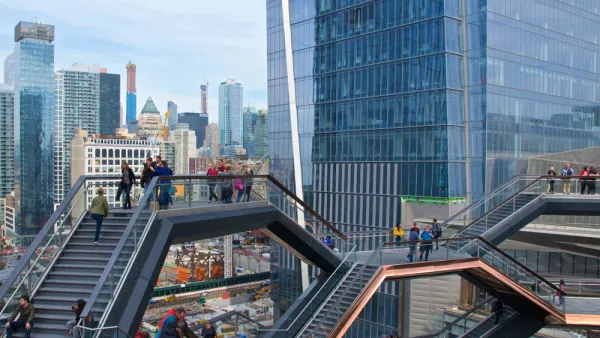
Matthew Haag reports for The New York Times on the curious case of the hotel on 11th Avenue in Hudson Yards. “At 642 feet tall, the building soars above the Hudson River, featuring jagged sets of floor-to-ceiling windows that shimmer in the sun,” writes Haag.
Here’s the catch: the architect of record on the project, Warren L. Schiffman, is on the record saying he had no role in designing the project. The same is true for other projects from the same developer, Marx Development Group: a hotel near La Guardia Airport (complete) and dual high-rise residences in Queens (still seeking approval), reports Haag.
New York state law requires buildings approved for construction to involve the oversight and involvement of a registered architect “to ensure that buildings are properly designed and do not pose a safety risk,” according to Haag.
So how’d the Hudson Yards hotel, currently under construction, get the permits necessary to build? “Officials at the city’s Department of Buildings said they did not find any structural defects in the plans for the Hudson Yards hotel, which is still under construction. Department records show that it reviewed the plans five times between 2018 and 2020, when they were ultimately approved,” according to Haag.
The department has since barred Schiffman from filing building plans, but more details on the fallout from the scandal are included in the source article below.
Read the full story: The Hotel Is 642 Feet Tall. Its ‘Architect’ Says He Never Saw the Plans.

Suicides Prompt New Public Access Rules for the Vessel at Manhattan's Hudson Yards
The Vessel is reopening after closing for four months due to a rash of suicides.

Vote for New York City's 'Building of the Year'
New York is still a place of bold architecture.

New York's Newest Neighborhood Also the Most Expensive
Hudson Yards, which opened to the public within the past year, is the most expensive neighborhood in all of New York City, according to a new report.

Planetizen Federal Action Tracker
A weekly monitor of how Trump’s orders and actions are impacting planners and planning in America.

Amtrak, CN end decades-long dispute with eight-year agreement
The new operating agreement establishes an updated framework for the companies to work together, including processes to resolve disputes.

Judges permit Denver to divert 77,000 acre feet from the Colorado River for reservoir expansion
Overuse and climate change have caused the Colorado River’s water levels to plummet.

NYC DOT wants faster, more permanent street upgrades
The city is examining ways to build more concrete infrastructure without getting entangled in 'decades-long' projects.

'Something we’ve never seen before:' rising utility rates could strain city finances nationwide
Data centers, climate change and other factors have caused utility rates in the United States to increase by 38% since 2020.

Trump to overrule local leaders, lease millions of acres of America’s Pacific Island territories’ seafloors to mining companies
International law says that the Indigenous people of America’s territories have a right to prior and informed consent regarding projects that impact their countries.

FREE Course: Walkable City 1: Why Walkability?
After describing his path towards focusing on walkability as the essence of good planning, Jeff Speck marches through his five principal reasons for making more walkable places.
Reinventing Malls: Planning Alchemy—Turning Gray Fields Into Gold
The course focuses on the opportunities and imperatives that shape reinvention of mall sites.

Harvard University Graduate School of Design
KFH Group Inc.
Greater Baltimore Committee
The Architects Foundation
University of Cincinnati Online
The Pocatello Development Authority
The Urban Renewal Agency of the City of Pocatello