One USDA program has given out over $1 billion in rural home repair grants since its inception, and could be inspiration for similar programs in urban and suburban communities as well.


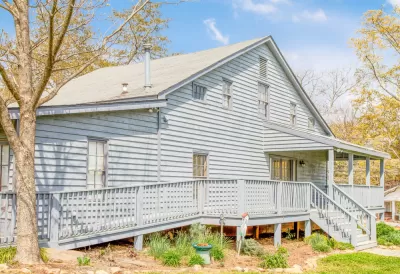
Betty Lunce is in her 70s and walks with a cane. A homeowner in Hazard, Kentucky, she found it difficult to leave her house. As Scott McReynolds, the executive director of the nonprofit Housing Development Alliance (HDA) explains, the back door led to three uneven, precarious steps with no handrail, and her long gravel driveway was near impassable due to deep ruts that had formed. Even though she no longer drove, the damaged driveway prevented any cars from pulling up to the home unless they had four-wheel drive. She and her family were unsure if an ambulance would be able to reach her home in an emergency. Even more concerning was her roof, which leaked in several spots including the kitchen and could lead to structural issues such as drywall damage or wood rot, and health issues such as the spread of mold.
All of that changed in December 2021, however, when Lunce received a new roof, an entry ramp, and a rebuilt driveway, for a total cost of $12,300, as part of a relatively unknown federal resource known as Section 504, and described as the U.S. Department of Agriculture’s (USDA) home repair loan and grant program for very low-income rural homeowners.
Lunce is one of many Americans living in rural communities who may own a home but have difficulty affording maintenance and repairs. The HDA worked with Lunce to qualify her for aid and link her to financing using Section 504. In addition to the loan and grant provided by the USDA program...
Read the full story: Leaky Roof? A USDA Home Repair Option


Planetizen Federal Action Tracker
A weekly monitor of how Trump’s orders and actions are impacting planners and planning in America.

Colorado’s Largest Data Center Could Rise Next to Homes — Without a Public Hearing
The proposed campus would consume 11 times the power of Denver International Airport; as it has across the country, opposition mounts.

Amtrak, CN end decades-long dispute with eight-year agreement
The new operating agreement establishes an updated framework for the companies to work together, including processes to resolve disputes.

'This is going to be painful:’ Virginia stares down $1.7 billion funding gap for highway maintenance
The state may address the deficit by shifting $290 million from its construction budget to maintenance projects.

Judges permit Denver to divert 77,000 acre feet from the Colorado River for reservoir expansion
Overuse and climate change have caused the Colorado River’s water levels to plummet.

Amtrak, CN end decades-long dispute with eight-year agreement
The new operating agreement establishes an updated framework for the companies to work together, including processes to resolve disputes.

FREE Course: Walkable City 1: Why Walkability?
After describing his path towards focusing on walkability as the essence of good planning, Jeff Speck marches through his five principal reasons for making more walkable places.
Reinventing Malls: Planning Alchemy—Turning Gray Fields Into Gold
The course focuses on the opportunities and imperatives that shape reinvention of mall sites.

KFH Group Inc.
Greater Baltimore Committee
Eagle County Government
The Architects Foundation
University of Cincinnati Online
The Pocatello Development Authority
The Urban Renewal Agency of the City of Pocatello