A bevy of real and unfounded claims against solar farms is feeding a growing opposition movement in rural areas.


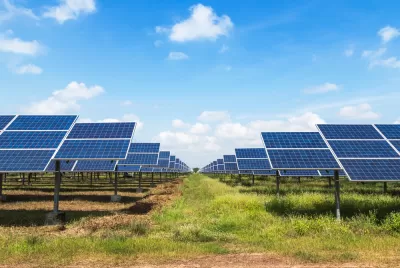
"Solar farms require huge amounts of land, and there’s a fast-growing movement, fueled by politicized social-media campaigns, to prevent solar developers from permitting new sites in rural America," reports Nichola Groom. "Solar currently makes up 3% of U.S. electricity supply and could reach 45% by 2050 to meet the Biden administration’s goals to eliminate or offset emissions by 2050, according to the Department of Energy. To get there, the U.S. solar industry needs a land area twice the size of Massachusetts, according to DOE."
Unlike the first big projects, located in remote, unpopulated areas, "tensions are rising as the sector plans bigger projects and reaches into more populated rural areas unfamiliar with solar." Now, "As solar developers propose new, often sprawling projects in places like Kansas, Maine, Texas, Virginia and elsewhere, local governments and activist groups are seeking to block them and often succeeding. They cite reasons ranging from aesthetics that would harm property values to fears about health and safety, and loss of arable land, farm culture, or wildlife habitat."
The article details the opposition groups, formed and organized primarily via Facebook, that lead efforts to stop large-scale solar projects using an array of real and false claims. While landowners are attracted by the high prices offered by solar companies, "It’s a harder sell to communities as a whole, which often see little economic upside to offset the downsides of large installations, which often create only one or two full-time jobs."
"Local pushback could delay plans by utilities to retire aging coal plants and replace them with solar projects to appease climate-conscious investors and regulators." Solar energy proponents are working to change public perception and address local concerns. "New Jersey, for instance, became a major market for solar despite the state’s dense development, primarily by putting projects on landfills or other disturbed land. And Minnesota has voluntary standards that encourage establishing pollinator-friendly vegetation at solar sites to reduce environmental opposition."
FULL STORY: Special Report: U.S. solar expansion stalled by rural land-use protests

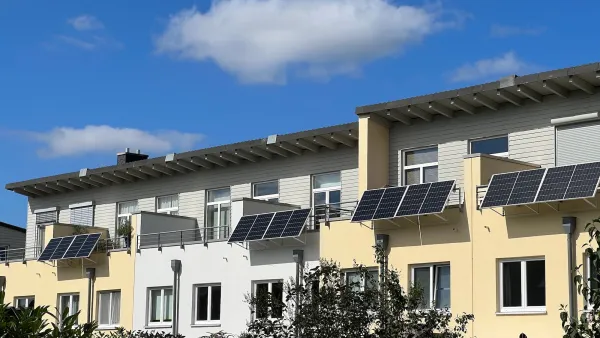
28 States and DC Could Legalize ‘Balcony Solar’
Plug-in solar panels, which are becoming popular across Europe, live in a regulatory gray area in the United States.
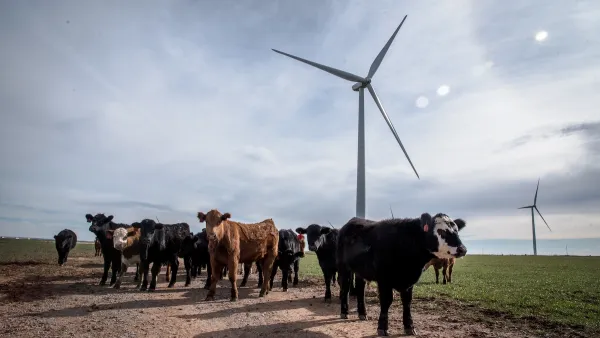
Renewable Energy Overtakes Coal for First Time
Solar and wind power generated close to a third of U.S. electricity supplies in 2024.
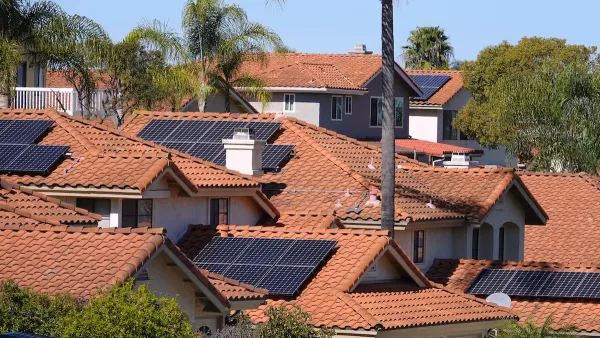
California Leads in Solar Rooftops
A combination of state and local incentives and building code mandates has helped California far outpace other states in residential rooftop solar permits.

Planetizen Federal Action Tracker
A weekly monitor of how Trump’s orders and actions are impacting planners and planning in America.

The state-sanctioned urbicide of Austin
People don’t kill cities. Freeways do.

US to reduce Colorado River water deliveries to Mexico
A new Colorado Treaty amendment reduces Mexico’s Colorado River water allocation by 250,000 acre feet.

5 New England states march closer to 800 megawatt wind energy project
Securing federal approval for the project may be complicated under the Trump administration, which has historically been hostile towards domestic wind power.

Baltimore to break ground on $50 million Transit Priority Project
The project will bring faster bus trips, safer streets and better bike connections to Baltimore.

Airbnb launches $250 million 'last-dollar financing' housing accelerator, makes first investment in Austin
The company will put $6.4 million towards affordable housing development in Texas’ capital.

FREE Course: Walkable City 1: Why Walkability?
After describing his path towards focusing on walkability as the essence of good planning, Jeff Speck marches through his five principal reasons for making more walkable places.
Reinventing Malls: Planning Alchemy—Turning Gray Fields Into Gold
The course focuses on the opportunities and imperatives that shape reinvention of mall sites.

Eagle County Government
Harvard University Graduate School of Design
Nashville Planning Department
The Architects Foundation
University of Cincinnati Online
The Pocatello Development Authority
The Urban Renewal Agency of the City of Pocatello
Journal of the American Planning Association