Despite the less-than-magical results of its experiment in Celebration, Florida, Disney has announced plans to build a chain of master-planned communities around the country.


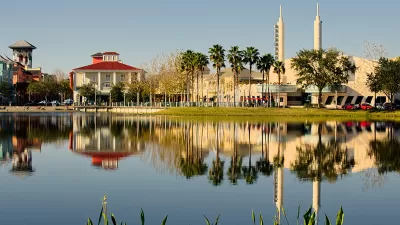
More than two decades after Disney's first foray into residential development, the company is launching a network of master-planned communities known as Storyliving by Disney, which "will feature distinctively designed spaces, unique amenities and Disney’s brand of world-renowned service," says the company. Disney plans to partner with third-party developers to build and maintain the communities. "With this latest venture, Disney apparently wants to revisit its residential dreams while focusing on the vague and eternally sunny concept of 'storytelling,'" writes James Vincent in The Verge.
According to an article by Herb Scribner, "The first location — called Contino, a Storyliving by Disney community — will be built in the Coachella Valley in Rancho Mirage, California'' and will include 1,900 new homes. Disney plans to provide a club membership and 'curated' experiences and programming for residents, as well as day passes for visitors.
Disney's vision of meticulously planned residential communities, an idea that Walt Disney introduced shortly before his death with his unrealized plan for the Experimental Prototype Community of Tomorrow (EPCOT), famously became a reality when the company opened Celebration, Florida in 1996. Since then, that town has struggled to live up to its early promises. By 2010, Celebration saw a foreclosure rate twice as high as the Florida state average. The company has not yet announced pricing or additional locations for the Storyliving communities.
Read the full story: Disney is developing planned communities for fans who never want to leave its clutches
Celebration, Florida: 20 Years Later
Disney's efforts to make a quaint American town both failed and succeeded in ways few could have predicted.

EPCOT: The Original 'Smart City'
What can today’s futurists learn from Disney’s unrealized utopia?
Hardly a Celebration
With a recent murder, a shootout-turned-suicide, and a high rate of foreclosure, the reality of Celebration, Florida, is less ideal than appearances would suggest.

Planetizen Federal Action Tracker
A weekly monitor of how Trump’s orders and actions are impacting planners and planning in America.

Washington state to charge fee to drivers with fuel-efficient cars
Revenue from the fee will go towards supporting the state’s highways.

Study reveals best places in the U.S. for cycling, walking
New research from Streetlight Data examines bicycle and pedestrian miles per capita in the 100 largest U.S. cities by population.

Mamdani unveils his ‘most ambitious bus lane project’ so far
The city has added two new bus lanes, which it expects to speed up tens of thousands of bus riders’ commutes.

New Jersey and New York suggest $10.3 billion budget for transit
Some of the budget is dedicated to replacing Manhattan's Midtown Bus Terminal.

States split over EPA’s proposal to drop greenhouse gas rules for power plants
The proposed rule drew over 165K comments, including from officials, health and environmental groups, and private citizens.

FREE Course: Walkable City 1: Why Walkability?
After describing his path towards focusing on walkability as the essence of good planning, Jeff Speck marches through his five principal reasons for making more walkable places.
Reinventing Malls: Planning Alchemy—Turning Gray Fields Into Gold
The course focuses on the opportunities and imperatives that shape reinvention of mall sites.

City of Charlotte
City of Rosemead
Rutgers University, Edward J. Bloustein School of Planning and Public Policy
University of Michigan School for Environment and Sustainability (SEAS)
Hunter College, City University of New York (CUNY)
The Architects Foundation
University District Partnership
City of Cambridge
The Pocatello Development Authority