Local residents of Brookings, Oregon say a local church's meal services during the pandemic were attracting crime and vagrancy, so the city passed a zoning ordinance that limited the number of days the church could serve meals to two a week.



"An Oregon church is suing the city of Brookings, Oregon, over limits the local government has imposed on how often it can serve free meals to the poor," according to an article by Christian Britschgi for Reason.
Last year, the city implemented zoning changes that limit churches in residential-zoned areas to serving meals only two days a week and require churches to acquire city permits to operate soup kitchens. Alex Hasenstab reported on the new law for OPB in October 2021.
"A federal lawsuit filed Friday by St. Timothy's Episcopal Church argues that Brookings' regulations on 'benevolent meal service' unconstitutionally restrict its religious mission to feed the hungry," explains Britschgi.
While a planner might reasonably question whether Brookings has run afoul of the Religious Land Use and Institutionalized Persons Act, the lawsuit cites the First Amendment to claim that the law is impeding the church's ability to practice its religion.
Britschgi has been covering the controversy since the city passed the law in October. "The city says that the new ordinance was crafted in response to concerns raised by neighbors near the local St. Timothy's Episcopal Church about the crime and vagrancy that its homeless services were bringing to the surrounding area," wrote Britschgi at the time.
Read the full story: Lawsuit: Crackdown on Church Soup Kitchens Violates the First Amendment
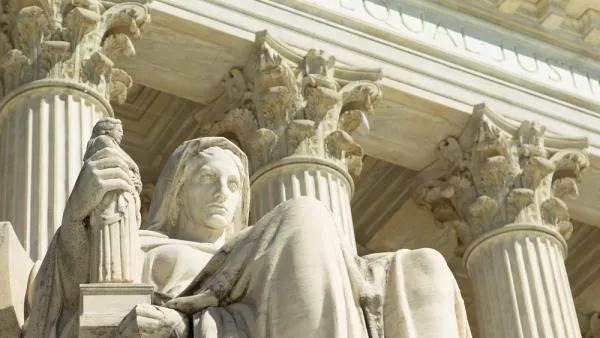
U.S. Supreme Court Rules on State-Imposed Social Distancing Restrictions
In a 5-4 decision, the court voted to uphold the prohibition of religious services that was part of California Gov. Gavin Newsom's stay-at-home order. While the restriction had since been loosened, the plaintiff wanted all restrictions removed.
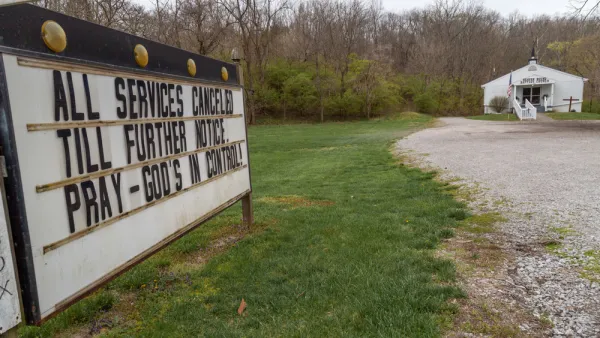
Religion in the Pandemic: First Amendment vs. Public Health and Safety
Conflicts between church and state are being decided in state and federal courts as governors act to protect their constituents from the coronavirus while religious institutions and their supporters seek exceptions from social gathering restrictions.

Cities Lose Supreme Court Case on Sign Regulation
The Supreme Court, in two separate opinions, unanimously ruled on June 18 against an Arizona town's sign regulation that denied the placement of a street sign based on its content. At question was a sign directing passers-by to a church service.

Planetizen Federal Action Tracker
A weekly monitor of how Trump’s orders and actions are impacting planners and planning in America.

California plans to bury El Niño’s downpour
If the state plays its cards right, it may be able to store a billion acre-feet of El Niño’s water in aquifers.

Desperate measures: Advocates weigh draining Lake Powell to fill Colorado River
Draining the reservoir could reduce evaporation losses by a couple hundred thousand acre-feet.

US buildings threatened, destroyed by fires set to triple by 2060
Researchers found a high fire risk for socioeconomically vulnerable neighborhoods in the American West.

LA residents may be allowed to paint their own crosswalks
Councilwoman Katy Yaroslavsky put out a motion instructing the Los Angeles Department of Public Transportation to study the feasibility of allowing volunteers to paint crosswalks.

Dallas moves to overhaul its zoning code
The city's zoning reform will allow more multi-family and mixed-use developments.

FREE Course: Walkable City 1: Why Walkability?
After describing his path towards focusing on walkability as the essence of good planning, Jeff Speck marches through his five principal reasons for making more walkable places.
Reinventing Malls: Planning Alchemy—Turning Gray Fields Into Gold
The course focuses on the opportunities and imperatives that shape reinvention of mall sites.

City of Rosemead
Rutgers University, Edward J. Bloustein School of Planning and Public Policy
One Hundred Miles
Hunter College, City University of New York (CUNY)
The Architects Foundation
University of Cincinnati Online
City of Cambridge
Montrose County
The Pocatello Development Authority