The fifth World Planning Schools Congress this coming August, organized on the theme Planning a Global Village: Inclusion, Innovation, and Disruption, will step up cross-border movement of planning ideas and practices.


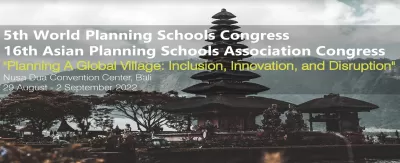
Planning educators will meet in Bali, Indonesia and virtually, August 29 - September 2, in what will be the fifth World Planning Schools Congress (WPSC). The Call for Submissions is now open with a deadline of February 28, as they seek involvement of teachers and researchers from universities around the globe.
Today's U.S. urban planning includes many practices that originated in diverse countries, including bus rapid transit (Brazil) and urban districts designed with the intention of periodic flooding (China). WPSC V is a rare opportunity to gather planning educators to exchange concepts and methods for planning from universities worldwide. The meeting, organized by the Association of Planning Schools of Indonesia (ASPI) for the Global Planning Education Association Network (GPEAN), involves eleven planning school associations and is expected to involve faculty from over 400 universities in more than 80 countries.
The Congress theme, Planning a Global Village: Inclusion, Innovation and Disruption, will be developed through 13 tracks ranging across the breadth of planning practice. Among the track chairs are U.S. scholars Casey Dawkins of the University of Maryland, College Park, Monica Haddad of Iowa State University, and Mi Shih of Rutgers University. Zorica Nedovic-Budic of the University of Illinois at Chicago is a member of the GPEAN Congress Steering Committee. Student opportunities connected to the Congress include a global doctoral colloquium, an international joint studio, and a student competition and exhibition.
U.N. Habitat Executive Director Maimunah Mohd. Sharif, University of Hong Kong professor Anthony Yeh, and Columbia University professor Saskia Sassen will be keynote speakers.
Calls for paper and session proposals to be selected competitively based on peer review are open until 28 February. Registration for the Congress will open 2 April.
Read the full story: World Planning Schools Congress website
Washington DC prepares for 4th of July with road closures, security checkpoints
The nation's capital is bracing for a series of large-scale events celebrating the nation's 250th anniversary.

Philadelphia officials say city is ready for World Cup
The city touted its plans to ensure security and accessibility during FIFA World Cup events.

MBTA threatens to use eminent domain to pedestrianize Boston streets during World Cup
Boston city hall has been unusually reluctant to align with MassDOT and MBTA's proposed crowd management plans.

Planetizen Federal Action Tracker
A weekly monitor of how Trump’s orders and actions are impacting planners and planning in America.

California plans to bury El Niño’s downpour
If the state plays its cards right, it may be able to store a billion acre-feet of El Niño’s water in aquifers.

Desperate measures: Advocates weigh draining Lake Powell to fill Colorado River
Draining the reservoir could reduce evaporation losses by a couple hundred thousand acre-feet.

Chicago voters approve permanent festival grounds, penalty for vacant property owners
Currently, major summer and fall festivals take over public parks for weeks at a time, drawing criticism from nearby residents

NYC votes to cut outdoor dining red tape, speed up permitting
New York City also voted to allow the Department of Transportation to begin work on urgent projects before notifying elected officials.

California appears to reject Prop. 45
The proposition would have expanded the projects that qualify for a streamlined environmental review, effectively paring down the California Environmental Quality Act.

FREE Course: Walkable City 1: Why Walkability?
After describing his path towards focusing on walkability as the essence of good planning, Jeff Speck marches through his five principal reasons for making more walkable places.
Reinventing Malls: Planning Alchemy—Turning Gray Fields Into Gold
The course focuses on the opportunities and imperatives that shape reinvention of mall sites.

City of Rosemead
Rutgers University, Edward J. Bloustein School of Planning and Public Policy
One Hundred Miles
Hunter College, City University of New York (CUNY)
The Architects Foundation
University of Cincinnati Online
City of Cambridge
Montrose County
The Pocatello Development Authority