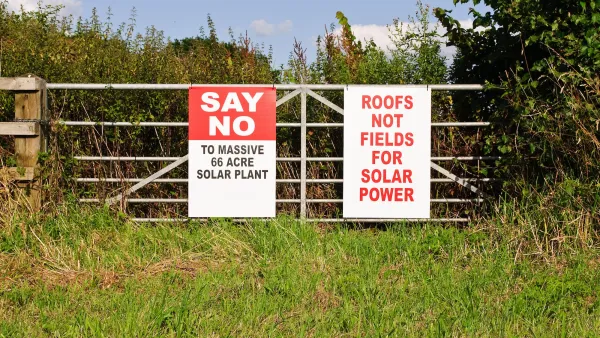
Large-scale solar developments face rising hostility from neighboring property owners who cite concerns about environmental degradation, reduced property values, and loss of farmland.



In response to complaints from nearby landowners, Pennsylvania's Delaware County has temporarily halted applications for solar farms in the county. As reported by Stephanie Wiechmann, "Landowners say they are worried about declining property values, panels they call 'toxic' polluting well water, and taking active farm ground out of commission." Some landowners complain about solar panels blocking the view from their property.
To resolve the issue, any proposed changes to the county's solar ordinance—such as larger setbacks between solar farms and adjacent properties or fencing and safety requirements—will have to pass through the Delaware-Muncie Metropolitan Plan Commission at a February meeting.
Solar farms around the country face increasingly strong opposition from neighboring property owners as energy companies plan to build industrial-scale solar developments in more diverse regions to meet a growing demand for renewable energy.
FULL STORY: Delaware County approves temporary solar energy moratorium to address landowner concerns


Solar Farm Moratorium to End, Despite Local Concerns
Delaware County plans to amend its solar zoning ordinance and lift a moratorium on the construction of new solar farms that was implemented after local opposition stalled the project.
Misinformation and 'AI slop' are hamstringing rural solar development
False claims about the potential drawbacks of solar farms are prompting some communities to reject potentially lucrative energy projects.
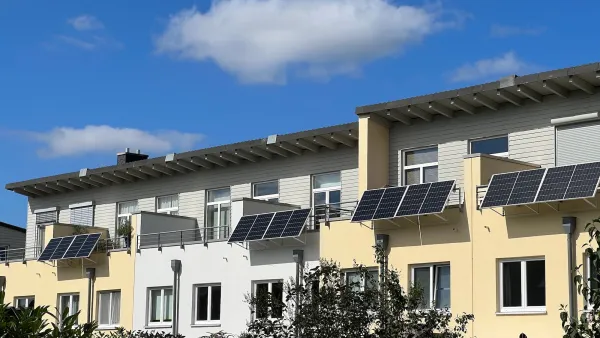
28 States and DC Could Legalize ‘Balcony Solar’
Plug-in solar panels, which are becoming popular across Europe, live in a regulatory gray area in the United States.

The state-sanctioned urbicide of Austin
People don’t kill cities. Freeways do.

US to reduce Colorado River water deliveries to Mexico
A new Colorado Treaty amendment reduces Mexico’s Colorado River water allocation by 250,000 acre feet.

New Jersey’s second-largest city bans standalone data centers
Jersey City will continue to allow co-location facilities, such as those meant for research institutions that store their own data.

Amtrak not solely to blame for New Jersey commuter rail's unreliability, report finds
A new study from the Garden State Initiative found that NJ Transit’s budget grew 20% across a 4 year period, but reliability declined significantly over the same period.

EPA erases limits on planet-warming pollution from power plants
Under Monday’s plan, power plants would still have some limits on how much mercury, arsenic and other contaminants they can emit.

Phoenix announces new on-demand transit service, more frequent RAPID buses
Both new services will launch in October, and are part of Phoenix's Project Effective Access Solutions for Easing Congestion.

FREE Course: Walkable City 1: Why Walkability?
After describing his path towards focusing on walkability as the essence of good planning, Jeff Speck marches through his five principal reasons for making more walkable places.
Reinventing Malls: Planning Alchemy—Turning Gray Fields Into Gold
The course focuses on the opportunities and imperatives that shape reinvention of mall sites.

Eagle County Government
Harvard University Graduate School of Design
Nashville Planning Department
The Architects Foundation
University of Cincinnati Online
The Pocatello Development Authority
The Urban Renewal Agency of the City of Pocatello
Journal of the American Planning Association