If the Supreme Court upholds a lower court decision, cities could lose a long-standing right to regulate 'off-premises' billboards.



A blog post from the American Planning Association (APA) details a U.S. Supreme Court case that could "upend much of modern sign regulation, and will force governments to reconsider their approaches to billboard controls."
The case, City of Austin v. Reagan National Advertising, Inc., concerns the distinction between on-and off-premises signs. In a lower court decision, the Fifth Circuit court ruled that the city's off-premises restriction—the advertisement of goods or services not provided at the same location as the billboard—was impermissible as it pertains to the content of the sign.
Now, the Supreme Court will decide whether to uphold the lower court's decision. If it does, cities will lose a decades-old regulatory technique that allowed them to regulate billboards and other advertisements.
Although it did not take a position on the case, the APA filed an amicus curae brief, stating, "we support ensuring that the rationales for sign regulation — community functionality, economic development, traffic safety, and aesthetic beautification — remain available to local governments, and we encourage the Court to adopt clear rules for the regulation of billboards."
FULL STORY: SCOTUS Case Could Upend Sign Regulations (Again)

Cities Lose Supreme Court Case on Sign Regulation
The Supreme Court, in two separate opinions, unanimously ruled on June 18 against an Arizona town's sign regulation that denied the placement of a street sign based on its content. At question was a sign directing passers-by to a church service.
San Jose City Council Supports New Billboards
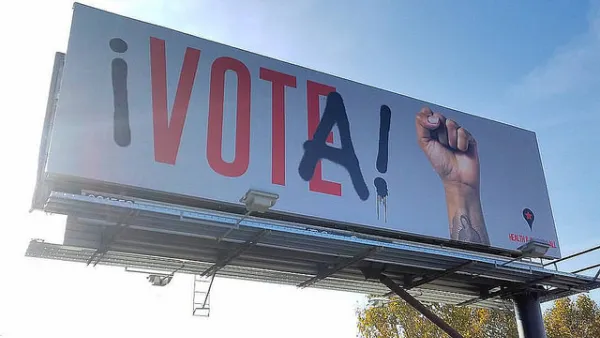
San Jose, California is suddenly taking a much more permissive approach to large billboards.
Another Chicago Skyscraper Sign Controversy
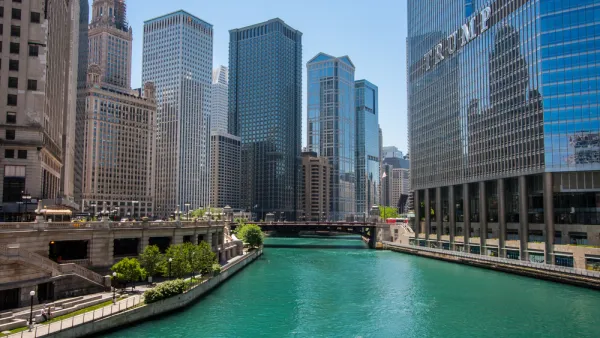
Regulations crafted in the wake of the Trump sign controversy of 2014 could be relaxed to let Salesforce leave its mark on the city of Chicago's skyline.

Planetizen Federal Action Tracker
A weekly monitor of how Trump’s orders and actions are impacting planners and planning in America.

The state-sanctioned urbicide of Austin
People don’t kill cities. Freeways do.

US to reduce Colorado River water deliveries to Mexico
A new Colorado Treaty amendment reduces Mexico’s Colorado River water allocation by 250,000 acre feet.

5 New England states march closer to 800 megawatt wind energy project
Securing federal approval for the project may be complicated under the Trump administration, which has historically been hostile towards domestic wind power.

Baltimore to break ground on $50 million Transit Priority Project
The project will bring faster bus trips, safer streets and better bike connections to Baltimore.

Airbnb launches $250 million 'last-dollar financing' housing accelerator, makes first investment in Austin
The company will put $6.4 million towards affordable housing development in Texas’ capital.

FREE Course: Walkable City 1: Why Walkability?
After describing his path towards focusing on walkability as the essence of good planning, Jeff Speck marches through his five principal reasons for making more walkable places.
Reinventing Malls: Planning Alchemy—Turning Gray Fields Into Gold
The course focuses on the opportunities and imperatives that shape reinvention of mall sites.

Eagle County Government
Harvard University Graduate School of Design
Nashville Planning Department
The Architects Foundation
University of Cincinnati Online
The Pocatello Development Authority
The Urban Renewal Agency of the City of Pocatello
Journal of the American Planning Association