A traditionally controversial planning exercise, the regular update of the 30-year plan for the San Francisco Bay Area, has crossed the finish line again. Opponents aren't letting the issues rest, however.



The Metropolitan Transportation Commission and the Association of Bay Area Governments adopted Plan Bay Area 2050 and its accompanying Environmental Impact report on Thursday, October 21. Planetizen last checked in with the 30-year regional plan when the two organizations released the draft for the nine-county regional plan in July 2020.
A summary of the vision put forward by Plan Bay Area 2050 are found in a press release announcing the adoption of the plan on October 21:
Defined by 35 strategies for housing, transportation, economic vitality and the environment, Plan Bay Area 2050 lays out a $1.4 trillion vision for policies and investments to make the nine-county region more affordable, connected, diverse, healthy and economically vibrant for all its residents through 2050 and beyond.
The press release claims the plan will produce more than one million new permanently affordable homes by 2050 and achieve a "groundbreaking focus on climate change," with strategies to create resilience from environmental risks like sea-level rise and wildfires.
Critics are skeptical, however, that the vision can be achieved with exacerbating the trends of gentrification and displacement that have defined the housing market in large swaths of the Bay Area in recent years (or decades).
Bobbi Lopez, policy director at Build Affordable Faster California and co-founder of the San Francisco Latino Democratic Club, pens an opinion piece criticizing Plan Bay Area 2050 for failing to work toward a more equitable and affordable Bay Area by relying too much on the market to deliver housing.
Lopez describes the plan as stuck in 1981: "I suppose its authors have turned a blind eye to corrupt real estate developers who have spent decades gentrifying our neighborhoods with fancy condominiums suited for the ultra-rich."
To achieve the plan's promised social equity, Lopez suggests funding homelessness programs, mandating a requirement that "50% of new housing developed on publicly-owned property be affordable for lower- and middle-income households," and making better choices about where to locate market-rate development. On that last point, Lopez writes: "Our region is home to hundreds of miles of empty shopping mall parking lots. With a little political will, that wasted blacktop could transform into new, market-rate apartment buildings, parks and small businesses — without displacing anyone."
Updated every five years, Plan Bay Area has provoked controversy in past iterations. Gentrification was among the criticisms of Plan Bay Area in 2015, for example. Opposition from environmentalists produced a protracted legal dispute that finally reached resolution in 2017. Right wing political interests, represented by the libertarian Pacific Legal Foundation, fought the Plan Bay Area process in 2013.
FULL STORY: Opinion: Plan Bay Area misses the mark for the working class

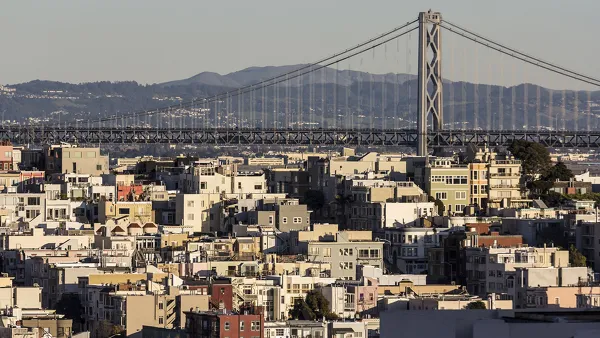
Plan Bay Area 2050 Draft Released
A regional plan for the nine-county San Francisco Bay Area is available for public comment.
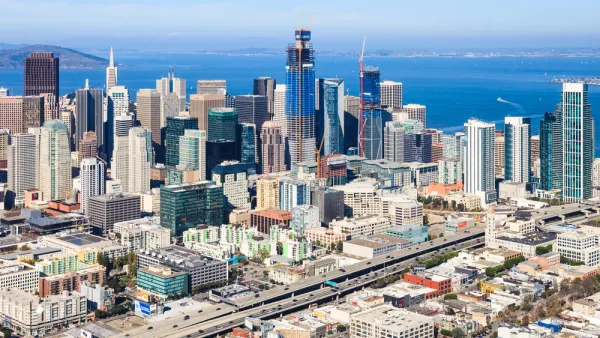
Plan Bay Area Update Calls for 30 Percent More Housing by 2040
The plan centers a large portion of the housing growth — around 46 percent — in the Big 3 Bay Area Cities: San Francisco, Oakland and San Jose.
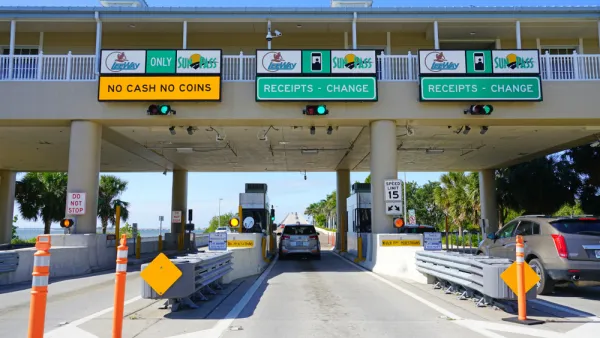
Tolling All Lanes
Bay Area transportation planners are studying a radical idea to reduce traffic congestion and fund driving alternatives: tolling all lanes on a freeway. Even more radical, the plan considers tolling parallel roads.

Planetizen Federal Action Tracker
A weekly monitor of how Trump’s orders and actions are impacting planners and planning in America.

The state-sanctioned urbicide of Austin
People don’t kill cities. Freeways do.

US to reduce Colorado River water deliveries to Mexico
A new Colorado Treaty amendment reduces Mexico’s Colorado River water allocation by 250,000 acre feet.

Mamdani overhauls NYC's Vision Zero plan with 100 new policy goals
The overhaul aims to reduce traffic deaths and make streets safer for pedestrians, cyclists and drivers through lower speed limits, new safety infrastructure and more.

Amtrak not solely to blame for New Jersey commuter rail's unreliability, report finds
A new study from the Garden State Initiative found that NJ Transit’s budget grew 20% across a 4 year period, but reliability declined significantly over the same period.

EPA erases limits on planet-warming pollution from power plants
Under Monday’s plan, power plants would still have some limits on how much mercury, arsenic and other contaminants they can emit.

FREE Course: Walkable City 1: Why Walkability?
After describing his path towards focusing on walkability as the essence of good planning, Jeff Speck marches through his five principal reasons for making more walkable places.
Reinventing Malls: Planning Alchemy—Turning Gray Fields Into Gold
The course focuses on the opportunities and imperatives that shape reinvention of mall sites.

Eagle County Government
Harvard University Graduate School of Design
Nashville Planning Department
The Architects Foundation
University of Cincinnati Online
The Pocatello Development Authority
The Urban Renewal Agency of the City of Pocatello
Journal of the American Planning Association