Traffic safety analysis inspires debate about the culprit (drivers or engineers?) on the least safe stretch of road in the Buckeye State.


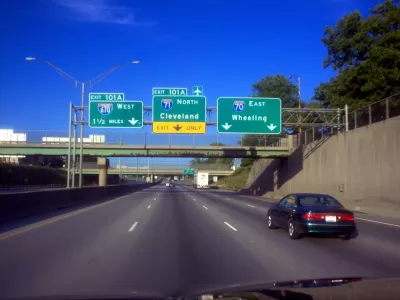
"An analysis of the latest federal fatal traffic crash data found that a portion of Interstate 71 in Columbus ranked as the deadliest 5-mile stretch of roadway in Ohio during a three-year period," reports Eric Lagatta.
Lagatta is sharing findings from analysis by MoneyGeek of National Highway Traffic Safety Administration data. The study analyzed "data on fatal crashes between 2017 and 2019 and found that 10 fatal crashes occurred on I-71 between 11th Avenue to the south and Morse Road to the north — the most for any 5-mile stretch in the state," explains Lagatta.
The Ohio Department of Transportation in August completed the "South Side Mega Fix" widening project on a seven-mile stretch of I-71 between Interstate-70 and Stringtown Road—located to the south of the five-mile stretch identified by the MoneyGeek analysis.
In a follow up article to the coverage by Lagatta, Theodore Decker put the study's findings to the test [paywall] by driving the stretch on a continuous loop in heaby rain, "exiting repeatedly at 11th Avenue on the south and Morse Road on the north, only to merge right back on the freeway and the loop over."
While Decker reports numerous bad driving behaviors, the article also sets up Ohio Department of Transportation officials with a case to widen the freeway, like it did to the south, to relieve bottlenecks and congestion. "On deadly stretch of I-71, the road may be getting a bad rap," reads the headline, and Decker assigns blame for the poor safety record of the freeway to drivers speeding and driving recklessly in poor weather conditions: "I-71 between 11th and Morse has its share of design problems, and ODOT needs to fix them. But the fact of the matter is this: The deaths on that stretch often were the result of individuals making bad choices. And those individuals were not the civil engineers."
FULL STORY: Five-mile stretch of Interstate-71 in Columbus ranks as deadliest in Ohio, analysis finds

Construction Set to Begin on $1.6 Billion Highway Widening in Texas
Construction is expected to begin on the Southeast Connector highway widening project near Fort Worth in the spring and wrap up in 2027.

Let’s End Traffic Stops
The technology to make traffic enforcement obsolete is becoming available. But in the U.S. willing to use it?

Ohio Pledges $51 Million for Traffic Safety
The state’s department of transportation will invest in a variety of traffic safety projects as traffic fatalities reach their highest level in decades.

Planetizen Federal Action Tracker
A weekly monitor of how Trump’s orders and actions are impacting planners and planning in America.

The state-sanctioned urbicide of Austin
People don’t kill cities. Freeways do.

US to reduce Colorado River water deliveries to Mexico
A new Colorado Treaty amendment reduces Mexico’s Colorado River water allocation by 250,000 acre feet.

5 New England states march closer to 800 megawatt wind energy project
Securing federal approval for the project may be complicated under the Trump administration, which has historically been hostile towards domestic wind power.

Baltimore to break ground on $50 million Transit Priority Project
The project will bring faster bus trips, safer streets and better bike connections to Baltimore.

Airbnb launches $250 million 'last-dollar financing' housing accelerator, makes first investment in Austin
The company will put $6.4 million towards affordable housing development in Texas’ capital.

FREE Course: Walkable City 1: Why Walkability?
After describing his path towards focusing on walkability as the essence of good planning, Jeff Speck marches through his five principal reasons for making more walkable places.
Reinventing Malls: Planning Alchemy—Turning Gray Fields Into Gold
The course focuses on the opportunities and imperatives that shape reinvention of mall sites.


Eagle County Government
Harvard University Graduate School of Design
Nashville Planning Department
The Architects Foundation
University of Cincinnati Online
The Pocatello Development Authority
The Urban Renewal Agency of the City of Pocatello
Journal of the American Planning Association