TransitCenter's "Safety for All" report provides a counterargument to the "send more police" response to public safety concerns on public transit systems.


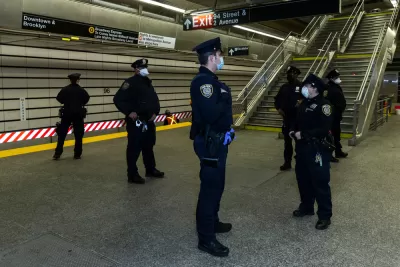
Sandy Smith shares news of a new report published by TransitCenter, "Safety for All," which studies the issue of public safety on public transit systems and produces a potentially counterintuitive conclusion: "transit systems overall rely too much on police to serve as the guarantors of safety."
As Smith notes, this conclusion has long been the opinion of many transit advocates, who have pointed to the poor track record of police with race and noted that for many, police are a deterrent for the use of public transit.
"Police, the report says, are also ill-trained and ill-equipped to deal with unhoused people riding transit, who often cause passenger discomfort simply by existing," explains Smith.
Among the case studies examined by the report are efforts to rethink public safety on BART in the San Francisco Bay Area and Tri-Met in Portland. Also,, writes Smith, "One of the innovative approaches it highlights is Philadelphia’s Hub of Hope, a service center located in a subway concourse, jointly run by SEPTA and Project HOME, that offers bathrooms, showers, meals and other services for homeless individuals."
FULL STORY: Report: Fewer Cops Can Make Transit Safer for All

German Cities Subsidize Taxis for Women Amid Wave of Violence
Free or low-cost taxi rides can help women navigate cities more safely, but critics say the programs don't address the root causes of violence against women.
Crime Continues to Drop on Philly, San Francisco Transit Systems
SEPTA and BART both saw significant declines in violent crime in the first quarter of 2025.
Study: How To Make Transit Safer
A new report recommends boosting ‘ambassador programs,’ improving reliability and frequency, and supporting more anti-harassment initiatives.

Planetizen Federal Action Tracker
A weekly monitor of how Trump’s orders and actions are impacting planners and planning in America.

The state-sanctioned urbicide of Austin
People don’t kill cities. Freeways do.

US to reduce Colorado River water deliveries to Mexico
A new Colorado Treaty amendment reduces Mexico’s Colorado River water allocation by 250,000 acre feet.

5 New England states march closer to 800 megawatt wind energy project
Securing federal approval for the project may be complicated under the Trump administration, which has historically been hostile towards domestic wind power.

Baltimore to break ground on $50 million Transit Priority Project
The project will bring faster bus trips, safer streets and better bike connections to Baltimore.

Airbnb launches $250 million 'last-dollar financing' housing accelerator, makes first investment in Austin
The company will put $6.4 million towards affordable housing development in Texas’ capital.

FREE Course: Walkable City 1: Why Walkability?
After describing his path towards focusing on walkability as the essence of good planning, Jeff Speck marches through his five principal reasons for making more walkable places.
Reinventing Malls: Planning Alchemy—Turning Gray Fields Into Gold
The course focuses on the opportunities and imperatives that shape reinvention of mall sites.

Eagle County Government
Harvard University Graduate School of Design
Nashville Planning Department
The Architects Foundation
University of Cincinnati Online
The Pocatello Development Authority
The Urban Renewal Agency of the City of Pocatello
Journal of the American Planning Association