A new methodology can help cities assess the impact of new developments on walkers.


While planners frequently use forecasting models to predict the impact of new developments on traffic, congestion, and road quality, no such model existed for assessing the effects of development on non-drivers. Now, reports Kea Wilson for Streetsblog, "Massachusetts Institute of Technology Researcher Andres Sevstuk has created a sophisticated new methodology for estimating changes in the volume of walkers on city streets at different times throughout the day in response to changes in the built environment, in much the same way that planners estimate how vehicle traffic will change after they break ground on a building or roadway redesign."
Similar traffic impact assessments (TIAs) are frequently used to evaluate the impact of projects. According to researcher Andres Sevstuk, "if the TIA forecast that a project would put more traffic onto city streets than the current road design can tolerate, then the developer typically has to pay to address that — maybe by building extra parking, or paying to widen a road, or paying to adjust traffic signal timing." Sevstuk argues that adding more infrastructure for counting pedestrians could have a "dramatic effect" on our understanding of how land use affects walking in cities.
Sevstuk's model, writes Wilson, "would be re-calibrated by each community using at least some local walking data, but even without those inputs, it can predict pedestrian volumes with roughly 70 to 80 percent accuracy." This information can help cities decide where to build amenities like parks or parking lots and serve as "a critical tool to identify where to prioritize pedestrian improvements that planners haven’t even considered yet." Further, "[o]verlaying projections with actual pedestrian crash data and data on corridors that have been historically disinvested could be even more helpful as leaders work towards ending traffic violence and making cities more equitable."
Read the full story: New Traffic Model Predicts How New Developments Will Affect Walkers


'The World's Most Beautiful Avenue' Getting A Green Makeover
Paris Mayor Anne Hidalgo approved a new plan to revitalize the Champs Élysées ahead of the 2024 Summer Olympics.

The number of kids walking to school dropped from over 50% to 11% since the 1960s
Unsafe pedestrian infrastructure makes walking to school dangerous or impossible for a growing number of American students.
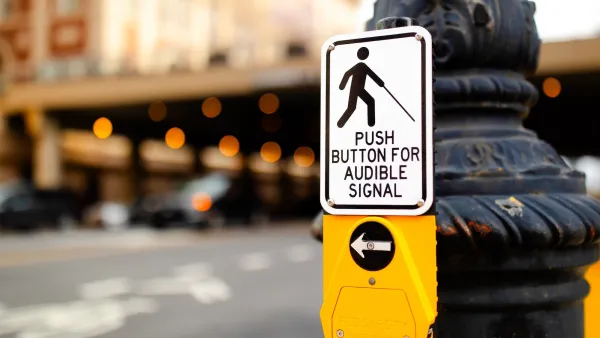
Report: Chicago surpassed its legal mandate for accessible pedestrian signals — but none passed inspections
Gaps in accessibility, placement and functionality highlight the importance of regular inspections and maintenance.

Amtrak, CN end decades-long dispute with eight-year agreement
The new operating agreement establishes an updated framework for the companies to work together, including processes to resolve disputes.

Judges permit Denver to divert 77,000 acre feet from the Colorado River for reservoir expansion
Overuse and climate change have caused the Colorado River’s water levels to plummet.

Nation's most wind-powered state turns to coal as data centers increase energy demand
For the first time in decades, Iowa has increased its generation of coal power.

Boston has spent millions making the Green Line more accessible — and there’s no end in sight
While the city has invested millions into expanding and adding platforms to the Green Line to make it more accessible, new train cars set to arrive next year will be too tall for disabled passengers to board without raising the current platforms.

Idaho may see an 18% drop in federal surface transit funding — the largest estimated cut in the US
Transit systems in rural communities are much more reliant on federal funding to provide their services.

How ‘post-disaster gentrification’ alters neighborhoods after natural calamities
After hurricanes, fires or other calamities, the original residents of a community are often replaced by younger, wealthier residents.

FREE Course: Walkable City 1: Why Walkability?
After describing his path towards focusing on walkability as the essence of good planning, Jeff Speck marches through his five principal reasons for making more walkable places.
Reinventing Malls: Planning Alchemy—Turning Gray Fields Into Gold
The course focuses on the opportunities and imperatives that shape reinvention of mall sites.

City of Wisconsin Rapids
Harvard University Graduate School of Design
KFH Group Inc.
The Architects Foundation
University of Cincinnati Online
The Pocatello Development Authority
The Urban Renewal Agency of the City of Pocatello