Riverdale, once a thriving community, has lost its industrial businesses, leaving unemployment and brownfield sites behind them.


"When landlords are absent, housing complexes can decline from a variety of problems: maintenance failure, unsuspecting residents taken advantage of through overcharging for basic services or not providing them at all, or unresponsiveness to village efforts to enforce building, health and fire codes. In the Village of Riverdale, this is happening in a subdivision called Pacesetter, and this is the problem that local leaders presented to a recent Technical Assistance Panel co-sponsored by the Campaign for Sensible Growth and the Urban Land Institute (ULI) Chicago. After a two-day, intensive analysis of the problem, the panel presented the Village with a bold plan for turning Pacesetter around by encouraging home ownership for the 300-plus units, adding social services for the community and opening up the community physically by removing some units to make way for street extensions." [Editor's Note: The link below is to a 500K PDF document.]
Thanks to Campaign for Sensible Growth listserv
Read the full story: Park Forest: Building on a Legacy, Building a New Downtown and Riverdale


Planetizen Federal Action Tracker
A weekly monitor of how Trump’s orders and actions are impacting planners and planning in America.

‘Going backwards:’ Baltimore mayor, students rally against state's transit funding plan
Maryland's proposed six-year plan provides no funding for Baltimore’s BMORE bus program and reduces its road maintenance funding.
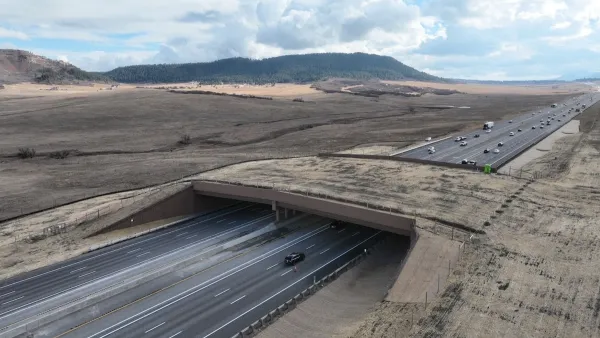
Record-breaking wildlife overpass in Colorado brings 91% reduction in animal collisions
Prior to the overpass, vehicles were hitting one deer per day on Colorado’s Interstate 25.

Mamdani sent nearly 6,000 pied-à-terre tax warnings to homes that didn’t qualify
A judge has ordered the administration to cancel thousands of pied-à-terre tax notices after it sent 35% of them erroneously.

Detroit to transform waterfront with $2.2 billion investment
Developers will convert about 18 acres of unused parking lot space into civic spaces.

‘Going backwards:’ Baltimore mayor, students rally against state's transit funding plan
Maryland's proposed six-year plan provides no funding for Baltimore’s BMORE bus program and reduces its road maintenance funding.

FREE Course: Walkable City 1: Why Walkability?
After describing his path towards focusing on walkability as the essence of good planning, Jeff Speck marches through his five principal reasons for making more walkable places.
Reinventing Malls: Planning Alchemy—Turning Gray Fields Into Gold
The course focuses on the opportunities and imperatives that shape reinvention of mall sites.

City of Thousand Oaks
City of Wisconsin Rapids
Harvard University Graduate School of Design
The Architects Foundation
University of Cincinnati Online
Northern Illinois Transit Authority (NITA)
The Pocatello Development Authority
The Urban Renewal Agency of the City of Pocatello