Cambridge, Massachusetts has opened all residential neighborhoods to the development of apartments buildings with 100 percent affordable units. It might be the most "sweeping attack on elitist and racist single family zoning" in the country.


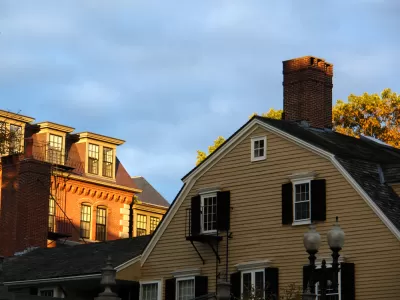
"Cambridge, Massachusetts made history last [week]," reports Randy Shaw. "The City Council enacted a 100% citywide affordable housing overlay (AHO) that should become a new national model for high-rent cities."
"The AHO opens up four story affordable apartments to all neighborhoods. Six and seven stories are allowed in business districts," explains Shaw.
The influence of Cambridge's action is already spreading in the immediate area around Boston: "Cambridge’s AHO is already influencing neighboring Somerville, which may already have the political support to pass a similar measure. Newton, which strongly backed a new housing development in a March 3, 2020 referendum, is also considering AHO-type legislation."
Another article by Adam Sennott reports the news, providing other pertinent details.
The overlay district will allow incremental increases in density, limited increases in height and relaxation of other zoning limitations for residential developments in which all units are made permanently affordable to households earning up to 100% of area median income. At least 80% of the units within an AHO project must be occupied by households whose gross household income upon initial occupancy is no more than 80% of the area median income, according to the policy order passed at Monday’s council meeting.
Rent, including utilities and any other routine fees, cannot exceed 30% of the gross household income of the AHO eligible household. Households can continue to rent units even if their income exceeds eligibility requirements as long as their income does not exceed 120% of the area median income.
Yet another article by Dan Eisner explains the advocacy efforts that made the historic-making AHO possible, giving credit to both organizations who built the political movement and the politicians who "bravely supported" the AHO. "In the world of housing activism, opponents of new housing never rest. They like their neighborhoods the way they are and often have lots of time on their hands," writes Eisner. "They usually win. But not this time."
The AHO now joins a growing roster of legislative actions to relax the restrictions of single-family zoning in the country, following the lead of city of Minneapolis and the state of Oregon, and the city of Portland more recently. Voters in the California city of Alameda will have a chance to end single-family zoning by referendum in November.
FULL STORY: ‘An important social-justice moment:’ Cambridge councilors pass Affordable Housing Overlay


100 Percent Affordable Overlay: Next Up for Berkeley's Reform Movement
After moving forward with parking and zoning reforms, the Berkeley City Council is also considering a new Affordable Housing Overlay on a model previously adopted in Cambridge, Massachusetts.

Colorado Mountain Communities Line Up to Oppose Statewide Zoning Reforms
State preemption isn’t going over well with local government officials in the remote corners of Colorado.

L.A. Planning Department Adjusts to State Housing Laws
Los Angeles Director of Planning Vince Bertoni was recently interviewed the effects of new state planning and housing laws in the state’s most populous city.

Planetizen Federal Action Tracker
A weekly monitor of how Trump’s orders and actions are impacting planners and planning in America.

The state-sanctioned urbicide of Austin
People don’t kill cities. Freeways do.

US to reduce Colorado River water deliveries to Mexico
A new Colorado Treaty amendment reduces Mexico’s Colorado River water allocation by 250,000 acre feet.

Mamdani overhauls NYC's Vision Zero plan with 100 new policy goals
The overhaul aims to reduce traffic deaths and make streets safer for pedestrians, cyclists and drivers through lower speed limits, new safety infrastructure and more.

Amtrak not solely to blame for New Jersey commuter rail's unreliability, report finds
A new study from the Garden State Initiative found that NJ Transit’s budget grew 20% across a 4 year period, but reliability declined significantly over the same period.

EPA erases limits on planet-warming pollution from power plants
Under Monday’s plan, power plants would still have some limits on how much mercury, arsenic and other contaminants they can emit.

FREE Course: Walkable City 1: Why Walkability?
After describing his path towards focusing on walkability as the essence of good planning, Jeff Speck marches through his five principal reasons for making more walkable places.
Reinventing Malls: Planning Alchemy—Turning Gray Fields Into Gold
The course focuses on the opportunities and imperatives that shape reinvention of mall sites.

Eagle County Government
Harvard University Graduate School of Design
Nashville Planning Department
The Architects Foundation
University of Cincinnati Online
The Pocatello Development Authority
The Urban Renewal Agency of the City of Pocatello
Journal of the American Planning Association