The Ohio Department of Transportation wants to add lanes to Interstate 77 outside Akron to reduce congestion. Some local officials think the project will connect the region to the East Coast; others think the money would be better spent locally.


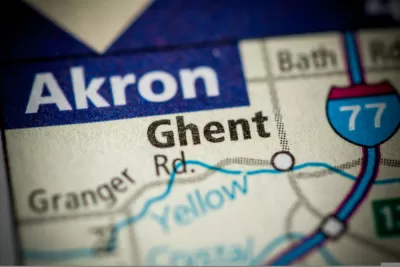
"The Ohio Department of Transportation is seeking feedback on its $125 million plans to add lanes to a 9.2-mile section of Interstate 77 in Summit County, a project that already has some detractors," reports Robin Goist.
Those detractors are Jason Segedy, Akron’s director of planning and urban development, and Becky Corbett, trustee of the Bath Township. Segedy's criticisms of the project focus on the spending priorities exhibited by the project. Segedy says the money would do more good in the urban core, and that ODOT should follow the city of Akron's lead in adopting a "fix it first" approach to transportation infrastructure. Corbett argues that the project's impermeable pavement will exacerbate stormwater challenges in the areas around the project.
The criticisms stand in contrast to the views expressed in an earlier article by Goist, which found support for the project from Summit County Executive Ilene Shapiro announced through a spokesperson support for the project for economic development purposes. State Rep. Emilia Sykes of Akron expressed support for the project on similar grounds. The Summit County economic development website makes the case for the highway project by touting the region's proximity to the outside world. The county is located within an "eight-hour drive of half of the U.S. population and two-thirds of the Canadian economic base. In addition to being centrally located between Cleveland, Detroit, Columbus and Pittsburgh, metropolitan markets within a 500 miles radius of Summit County include New York City, Washington, D.C., Chicago and Nashville," according to Goist.
For more details on the proposed project, Goist provides the following in the more recent article:
ODOT announced earlier this month its plans to add a third lane in each direction to I-77 between Ghent Road and the Ohio Turnpike, which spans Fairlawn, Bath, Richfield Township and the Village of Richfield. The construction project has been divided in two, with the stretch from Ghent Road to Everett Road expected to cost $50 million, and the section from Everett Road to the Ohio Turnpike estimated to cost $75 million.
In the previous article, Goose provides the following additional information about ODOT's decision to widen the freeway:
ODOT said it has conducted traffic studies and determined that a third travel lane in each direction would improve traffic flow, and that the best course of action would be to build additional lanes in the center median. The project also calls for other improvements, including bridge and pavement repairs, drainage improvements, lighting upgrades, sign replacements and pavement markings, according to ODOT.

Research Triangle Region Cuts Back Highway Widening Plans
The Durham-Chapel Hill-Carrboro Metropolitan Planning Organization accomplished a major shift in transportation planning priorities.
Reconciling Highway Investments With Climate Plans
The Colorado Department of Transportation has plans to expand highways, but it also has a mandate to reduce emissions from the state's transportation systems. Is it possible to do both?
Widening, Other Improvements Planned for the 'Boeing Freeway'
The Washington State Department of Transportation is proposing a series of changes to State Route 526 that includes a new eastbound travel lane.

Planetizen Federal Action Tracker
A weekly monitor of how Trump’s orders and actions are impacting planners and planning in America.

The state-sanctioned urbicide of Austin
People don’t kill cities. Freeways do.

US to reduce Colorado River water deliveries to Mexico
A new Colorado Treaty amendment reduces Mexico’s Colorado River water allocation by 250,000 acre feet.

Colorado’s Largest Data Center Could Rise Next to Homes — Without a Public Hearing
The proposed campus would consume 11 times the power of Denver International Airport; as it has across the country, opposition mounts.

5 New England states march closer to 800 megawatt wind energy project
Securing federal approval for the project may be complicated under the Trump administration, which has historically been hostile towards domestic wind power.

Baltimore to break ground on $50 million Transit Priority Project
The project will bring faster bus trips, safer streets and better bike connections to Baltimore.

FREE Course: Walkable City 1: Why Walkability?
After describing his path towards focusing on walkability as the essence of good planning, Jeff Speck marches through his five principal reasons for making more walkable places.
Reinventing Malls: Planning Alchemy—Turning Gray Fields Into Gold
The course focuses on the opportunities and imperatives that shape reinvention of mall sites.

Eagle County Government
Harvard University Graduate School of Design
Nashville Planning Department
The Architects Foundation
University of Cincinnati Online
The Pocatello Development Authority
The Urban Renewal Agency of the City of Pocatello
Journal of the American Planning Association