Pedestrians in Arlington County, Virginia can be fined for gathering on sidewalks in groups larger than three.


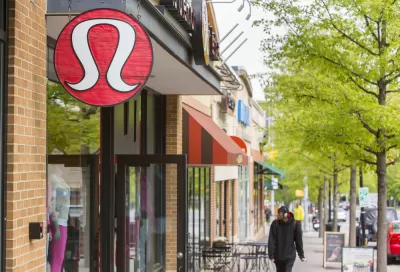
While many cities have expanded the capacity of restaurants and retail businesses to operate in the public realm on sidewalks, streets, and parking spaces, Arlington County, Virginia is trying to limit the size of crowds on sidewalks.
The Arlington County Board recently approved "an emergency ordinance banning groups larger than three from congregating on streets and sidewalks when there are posted restrictions," reports Hannah Schuster. "Pedestrians must stay at least six feet apart in these areas."
"Anyone who violates the rule could face a fine of up to $100, though enforcement will only begin 'after a period of outreach and education,' and after signs explaining the policy are posted," according to Schuster.
The county board approved the new law the same night as social media images revealed large crowds of people gathering on a sidewalk in Clarendon, a wealthy neighborhood in the county, as shared by Tom Lynch, NBC Washington reporter, on Twitter.
This is a look at a sidewalk in Clarendon tonight as the Arlington County Board adopts an order that will prohibit groups of more than three from congregating on streets and sidewalks. Enforcement will start after "outreach and education" per the board's release @nbcwashington pic.twitter.com/qMUkMW4BJC
— Tom Lynch (@TomLynch_) August 1, 2020
The news about the new ordinance banning sidewalk gatherings is embedded about halfway through Schuster's coverage of COVID-19 trends in Washington, D.C., Northern Virginia, and Maryland.
Read the full story: Coronavirus Update: Maryland Hits Testing Milestone, Arlington Bans Crowds On Sidewalks

U.S. Supreme Court Rules on State-Imposed Social Distancing Restrictions
In a 5-4 decision, the court voted to uphold the prohibition of religious services that was part of California Gov. Gavin Newsom's stay-at-home order. While the restriction had since been loosened, the plaintiff wanted all restrictions removed.

Study: 36,000 American Lives Would Have Been Saved if White House Acted One Week Earlier
Research from Columbia University Mailman School of Public Health looks at the timing of the imposition of public health control measures, at the start of the pandemic and in the present if infections increase, to project lives saved or lost.
Religion in the Pandemic: First Amendment vs. Public Health and Safety
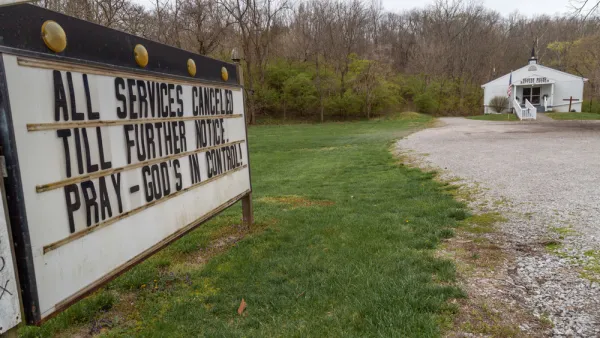
Conflicts between church and state are being decided in state and federal courts as governors act to protect their constituents from the coronavirus while religious institutions and their supporters seek exceptions from social gathering restrictions.

Planetizen Federal Action Tracker
A weekly monitor of how Trump’s orders and actions are impacting planners and planning in America.

The state-sanctioned urbicide of Austin
People don’t kill cities. Freeways do.

Colorado’s Largest Data Center Could Rise Next to Homes — Without a Public Hearing
The proposed campus would consume 11 times the power of Denver International Airport; as it has across the country, opposition mounts.

Nation's most wind-powered state turns to coal as data centers increase energy demand
For the first time in decades, Iowa has increased its generation of coal power.

NYC cools commuters with city's first rain garden above a bus stop
New York City officials say the plants in the rain garden can absorb 16 gallons of rainwater during heavy storms.

Brightline West’s future may rely on $6 billion federal loan
The company has until Nov. 2 to make a $400 million equity investment into its proposed high-speed rail line.

FREE Course: Walkable City 1: Why Walkability?
After describing his path towards focusing on walkability as the essence of good planning, Jeff Speck marches through his five principal reasons for making more walkable places.
Reinventing Malls: Planning Alchemy—Turning Gray Fields Into Gold
The course focuses on the opportunities and imperatives that shape reinvention of mall sites.

Greater Baltimore Committee
Eagle County Government
Harvard University Graduate School of Design
The Architects Foundation
University of Cincinnati Online
The Pocatello Development Authority
The Urban Renewal Agency of the City of Pocatello
Journal of the American Planning Association