In struggling communities full of single-family homes, the cost is too high for developers to acquire and renovate blighted properties. The Neighborhood Homes Investment Act would offer an incentive for investment in existing building stock.


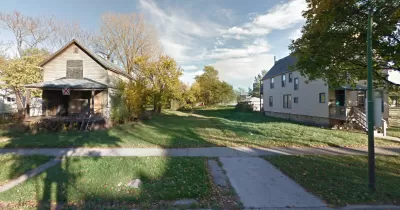
"Lawmakers have proposed a federal tax credit that would fuel the rehabilitation of deteriorated single-family homes in distressed neighborhoods," reports Donna Kimura.
"Introduced by Reps. Brian Higgins (D-N.Y.) and Mike Kelly (R-Pa.), the Neighborhood Homes Investment Act (NHIA) seeks to build on the success of the low-income housing tax credit (LIHTC) for multifamily housing properties," adds Kimura. The bill is known as H.R.3316 in the House.
The article includes more details about the proposed legislation, including the expected return on investment: "Supporters estimate the credit could produce 500,000 homes over 10 years and generate about $100 billion in development and 785,714 jobs in construction and related industries."
The Center for Community Progress recently released a press release announcing support for the companion act in the Senate, S.4073.
Read the full story: Bill Seeks to Create ‘Neighborhood Homes’ Tax Credit

Neighborhood Homes Investment Act Picks Up Momentum
A proposed tax credit designed to stabilize single-family neighborhoods facing growing numbers of vacancies is making its way through Congress.

Long Beach Urban Farming Initiative Targets Vacant Lots
A California policy lets cities offer tax incentives to landowners who put vacant lots to use as urban farms or gardens. Long Beach is the latest comer, but the uptake has been sluggish elsewhere.
Blight Is a Bad Word
What makes one building worth saving and another worth destroying? Strong Towns' Rachel Quednau explores the line between destruction and preservation.

Planetizen Federal Action Tracker
A weekly monitor of how Trump’s orders and actions are impacting planners and planning in America.

The state-sanctioned urbicide of Austin
People don’t kill cities. Freeways do.

US to reduce Colorado River water deliveries to Mexico
A new Colorado Treaty amendment reduces Mexico’s Colorado River water allocation by 250,000 acre feet.

Brightline West’s future may rely on $6 billion federal loan
The company has until Nov. 2 to make a $400 million equity investment into its proposed high-speed rail line.

LA Metro’s ultimatum: no extra buses for LA28 if federal funding isn’t imminently secured
If Metro does not provide additional buses, LA28 organizers will have to find a new way to manage Olympic traffic. LA28’s budget does not include a line item for transit.

Colorado’s Largest Data Center Could Rise Next to Homes — Without a Public Hearing
The proposed campus would consume 11 times the power of Denver International Airport; as it has across the country, opposition mounts.

FREE Course: Walkable City 1: Why Walkability?
After describing his path towards focusing on walkability as the essence of good planning, Jeff Speck marches through his five principal reasons for making more walkable places.
Reinventing Malls: Planning Alchemy—Turning Gray Fields Into Gold
The course focuses on the opportunities and imperatives that shape reinvention of mall sites.

Eagle County Government
Harvard University Graduate School of Design
Nashville Planning Department
The Architects Foundation
University of Cincinnati Online
The Pocatello Development Authority
The Urban Renewal Agency of the City of Pocatello
Journal of the American Planning Association