The United States currently tests about 145,000 people daily. A Harvard study calls for a minimum of 500,000 daily, but that's on the low end if the country wants to prevent shutting down again due to a second wave of the coronavirus.


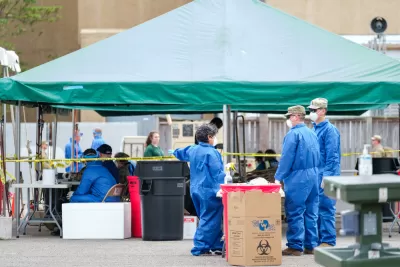
"An average of 146,000 people per day have been tested for the coronavirus nationally so far this month, according to the COVID Tracking Project, which on Friday reported 3.6 million total tests across the country," reports Keith Collins for the New York Times on April 17.
To reopen the United States by mid-May, the number of daily tests performed between now and then should be 500,000 to 700,000, according to the Harvard estimates.
The problem with the testing now is that the percentage of positive test results is too high, about a sign that the level of testing is insufficient.
“If you have a very high positive rate, it means that there are probably a good number of people out there who have the disease who you haven’t tested,” said Ashish Jha, the director of the Harvard Global Health Institute. “You want to drive the positive rate down, because the fundamental element of keeping our economy open is making sure you’re identifying as many infected people as possible and isolating them.”
The researchers said that expanded testing could reduce the rate to 10 percent, which is the maximum rate recommended by the World Health Organization. In Germany, that number is 7 percent, and in South Korea, it is closer to 3 percent. [According to Robinson Meyer and Alexis C. Madrigal of The Atlantic, it's 2 percent.]
The Harvard researchers that the rate of daily testing should be at a minimum of 152 tests per 100,000 people each day, a level reached only by Rhode Island. New York, which has conducted the most tests, is testing at 118 per 100,000 people.
A shortage of test kits and technical flaws in the United States significantly delayed more widespread testing of the virus, letting it spread undetected for weeks. With [almost 753,000 cases as of Sunday], the country has the highest number of known cases in the world. [Also on April 19, U.S. deaths from COVID-19 topped 40,000.]
Jha says that we'll have made progress when the current restrictions on testing have been eliminated.
“We need to switch from saying to people, ‘if you have mild symptoms, if you’re not feeling super sick, don’t come and stay at home,’ to ‘if you have any symptoms, you need to come in to get tested right away,’ ” he said.
New study calls for 5 million daily tests (to start)
Jha's colleague, Danielle Allen, a professor at Harvard University's Edmond J.Safra Center on Ethics, is the lead author of a report titled "Roadmap to Pandemic Resilience," set to be released on Monday, that calls for a much higher level of testing combined with two other public health strategies, reports ABC News on April 19.
"What people need to recognize is that a massively scaled-up testing, tracing and supported isolation system is the alternative to national quarantine," Allen said. "We all had to learn PPE [Personal Protective Equipment] and we all had to learn about flattening the curve ... now we have to learn about TTSI."
Test producers will need to deliver 5 million tests per day by early June to safely open parts of the economy by late July, according to the report. To "fully re-mobilize the economy," the country will need to see testing grow to 20 million a day, the report suggests.
Some experts, including Nobel laureate economist Paul Romer, who did not assist in the report but has a similar approach, estimate the country may need more than 30 million tests per day.
Allen appeared on ABC This Week on Sunday morning. George Stephanopoulos, the host, asked her to explain the danger of economic shutdowns being lifted before adequate testing is in place which could lead to future stay-at-home orders resulting from potential second and third waves of the virus.
Calling that approach "adaptive response" in disease control, she said that makes sense when dealing with a contained epidemic, "but it doesn't make sense when you have a global pandemic when entire countries are experiencing the disease, stressing the need for enough "testing, tracing, and supportive isolation to control the disease so we don't see a resurgence."
She then emphasized what Jha said earlier, the testing rate show a reduced percentage of positive results to match South Korea's level of 3 percent.
The blue-ribbon panel the authored the report consists of more than 45 economists, social scientists, lawyers and ethicists. As of posting time, a link to the report was unavailable. Look for it in the comments section below.
Additional reading:
- "The case for ending the Covid-19 pandemic with mass testing," by
-
"Opinion: The best way out of this pandemic is to massively scale up testing. Here’s how to do it," by Danielle Allen, The Washington Post, Apr 10, 2020
Read the full story: Coronavirus Testing Needs to Triple Before the U.S. Can Reopen, Experts Say


Academic Studies: Staying at Home Saved Millions of Lives Globally
Separate coronavirus studies from the University of California at Berkeley and Imperial College London published June 8 in the journal Nature show the life and health-saving value of domestic stay-at-home orders, global lockdowns, and other measures.

An Unlikely State Emerges as Nation's Premier Contact Tracer
The Peace Garden State is one of a handful of rural states never to have issued a stay-at-home order, yet it is number three in coronavirus testing per capita and number one in contact tracing, two of the four tools needed to contain COVID-19.

Coronavirus Success Stories
While the U.S. leads the world in COVID-19 infections and deaths, a small group of nations defied the odds and has shown remarkable success in containing the coronavirus. NPR investigates what they share in common, with a focus on New Zealand.

Planetizen Federal Action Tracker
A weekly monitor of how Trump’s orders and actions are impacting planners and planning in America.

California plans to bury El Niño’s downpour
If the state plays its cards right, it may be able to store a billion acre-feet of El Niño’s water in aquifers.

Chicago breaks ground on $3 billion megadevelopment
The new neighborhood, titled Foundry Park, will one day host 3,700 residences.

California High-Speed Rail Authority CEO resigns after $600,000 scandal
Under Ian Choudri, the authority used taxpayer dollars to fund first class flights and trips to nightclubs.

Want to study the Missouri River? Soon, you may need unanimous approval from 10 states
Legislation would require 10 governors’ permission to study or build projects moving water outside the basin.

Desperate measures: Advocates weigh draining Lake Powell to fill Colorado River
Draining the reservoir could reduce evaporation losses by a couple hundred thousand acre-feet.

FREE Course: Walkable City 1: Why Walkability?
After describing his path towards focusing on walkability as the essence of good planning, Jeff Speck marches through his five principal reasons for making more walkable places.
Reinventing Malls: Planning Alchemy—Turning Gray Fields Into Gold
The course focuses on the opportunities and imperatives that shape reinvention of mall sites.

City of Rosemead
Rutgers University, Edward J. Bloustein School of Planning and Public Policy
One Hundred Miles
Hunter College, City University of New York (CUNY)
The Architects Foundation
University of Cincinnati Online
City of Cambridge
Montrose County
The Pocatello Development Authority