A former industrial site on the edge of Portland, Oregon's urban core is planned with major urbanism ambitions.


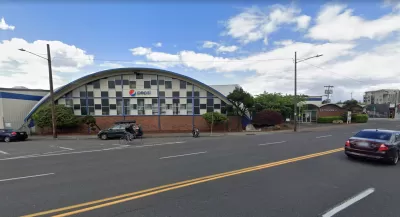
Will Macht, a professor of urban planning and development at the Center for Real Estate at Portland State University, writes to describe a pioneering development process for a "live/work/make/eat/shop" superblock in Portland.
"Finding four-and-a-half city blocks, including the land formerly occupied by internal streets, only 1.5 miles (2.4 km) from downtown Portland, Oregon, gave Seattle-based Security Properties the opportunity to develop the first project using the city’s new planned development review entitlement process established for large sites of over two acres (0.8 ha)," writes Macht.
The development, called Pepsi Blocks for its location at the former site of a Pepsi bottling plant, is planned to total 1.2 million square feet of space, comprising "up to 1,130 residential units, 450,000 square feet (42,000 sq m) of offices, and 30,000 square feet (2,800 sq m) of retail shops."
There's a lot more detail to the urbanism ambition of the development—like a shared street, or woonerf, on Pacific Street where it cuts through the development.
Read the full story: Bringing Mixed Uses—and Open Space—to a Multiple-Small-Block Development in Portland
Cascadia Expects Millions of New Residents. Should it Build New Cities or New Density?
A recent report calls for the region stretching from Oregon to British Columbia to think big about accommodating expected population growth. The report's recommendation to build four new, large cities isn't universally accepted, however.
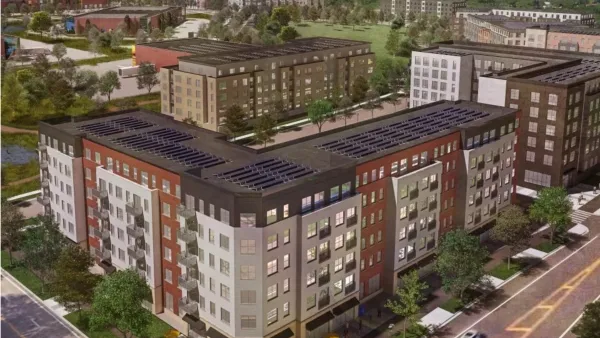
St. Paul Approves Master Plan for Thousands of New Jobs and Homes
A new neighborhood dubbed “The Heights” is planned for the East Side of St. Paul, Minnesota.
Draft West Portland Town Center Plan Seeks Public Comment
Always a closely watched planning jurisdiction, Portland, Oregon is proceeding with a new vision for the future of the western end of the city.

Planetizen Federal Action Tracker
A weekly monitor of how Trump’s orders and actions are impacting planners and planning in America.

California plans to bury El Niño’s downpour
If the state plays its cards right, it may be able to store a billion acre-feet of El Niño’s water in aquifers.

Desperate measures: Advocates weigh draining Lake Powell to fill Colorado River
Draining the reservoir could reduce evaporation losses by a couple hundred thousand acre-feet.

US buildings threatened, destroyed by fires set to triple by 2060
Researchers found a high fire risk for socioeconomically vulnerable neighborhoods in the American West.

LA residents may be allowed to paint their own crosswalks
Councilwoman Katy Yaroslavsky put out a motion instructing the Los Angeles Department of Public Transportation to study the feasibility of allowing volunteers to paint crosswalks.

Dallas moves to overhaul its zoning code
The city's zoning reform will allow more multi-family and mixed-use developments.

FREE Course: Walkable City 1: Why Walkability?
After describing his path towards focusing on walkability as the essence of good planning, Jeff Speck marches through his five principal reasons for making more walkable places.
Reinventing Malls: Planning Alchemy—Turning Gray Fields Into Gold
The course focuses on the opportunities and imperatives that shape reinvention of mall sites.

City of Rosemead
Rutgers University, Edward J. Bloustein School of Planning and Public Policy
One Hundred Miles
Hunter College, City University of New York (CUNY)
The Architects Foundation
University of Cincinnati Online
City of Cambridge
Montrose County
The Pocatello Development Authority