The success of the busway project could point to a longer-term shift away from planning and design strategies that favor cars.


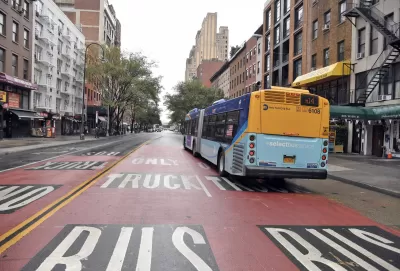
"The 14th Street Busway in New York City is a great case study in why drivers shouldn’t fight funding for transit—but should support it for their own good," writes Patrick Sisson.
Sisson reviews outcomes of the busway, including faster bus travel times and minimal impacts on car travel times as well as mode shifts in the area. "During its short existence so far, the Busway has boosted bus ridership 24 percent on weekdays and 30 percent on weekends. The impact has spilled over to Citi Bike, the city’s bike-share network; there’s been a 17 percent increase in bike usage on 14th Street during the morning commute, and ridership has also jumped on new protected bike lanes on 12th and 13th streets."
Over the long term, infrastructure like the 14th Street Busway benefits all road users. For one, the increase in transit ridership means fewer cars on city streets. "And while some drivers might not like the idea of sharing road space with buses, busways offer an incredibly cost-effective mass transit solution compared to light rail or subways," says Sisson.
Read the full story: How better bus lanes can fix everyone’s commute
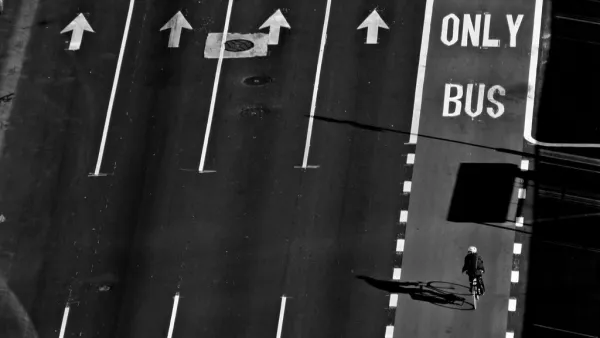
More Bus Lane Cameras Coming to N.Y.C.
New state legislation will allow the city to expand the network of cameras and step up enforcement.
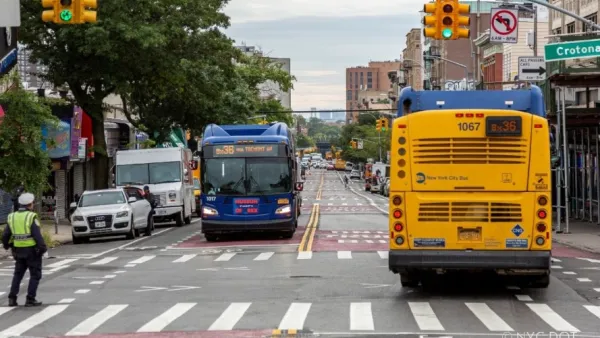
Buses travel at 5mph along this route in NYC. The Bronx's first-ever busway looks to change that
Prior to the busway, buses on the Bx36 route traveled as slowly as 5 miles per hour.
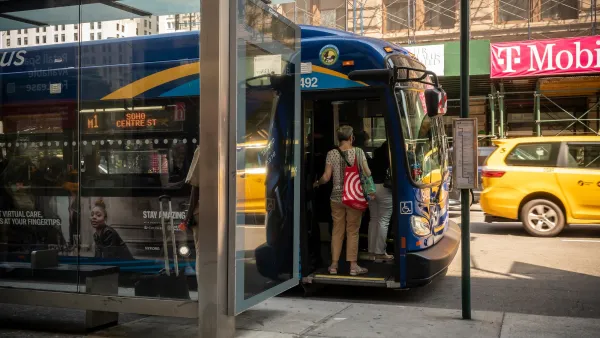
New NYC plan promises to speed up buses by up to 20%
Although the mayor's plan to make buses fare-free faces an uphill battle, a new proposal could make them significantly faster.

Planetizen Federal Action Tracker
A weekly monitor of how Trump’s orders and actions are impacting planners and planning in America.

California plans to bury El Niño’s downpour
If the state plays its cards right, it may be able to store a billion acre-feet of El Niño’s water in aquifers.

Desperate measures: Advocates weigh draining Lake Powell to fill Colorado River
Draining the reservoir could reduce evaporation losses by a couple hundred thousand acre-feet.

Mamdani’s pied-à-terre tax survives legal challenge
A panel of judges found that the plaintiffs failed to demonstrate injury as a result of New York City's implementation of the tax.

Eastern Nebraska is running out of electricity
Data centers and electrification are straining eastern Nebraska’s grid, throttling economic development.

Seattle passes record-breaking transit services expansion
Proposition 1 will double the city’s transit tax to add 95,000 more bus trips and preserve 180,000 bus trips annually.

FREE Course: Walkable City 1: Why Walkability?
After describing his path towards focusing on walkability as the essence of good planning, Jeff Speck marches through his five principal reasons for making more walkable places.
Reinventing Malls: Planning Alchemy—Turning Gray Fields Into Gold
The course focuses on the opportunities and imperatives that shape reinvention of mall sites.

City of Rosemead
Rutgers University, Edward J. Bloustein School of Planning and Public Policy
One Hundred Miles
University of Michigan School for Environment and Sustainability (SEAS)
Hunter College, City University of New York (CUNY)
The Architects Foundation
City of Cambridge
Montrose County
The Pocatello Development Authority