Sea levels are rising at an accelerating rate, continuing a trend that began in 2013 or 2014, and pushes coastal communities toward the extreme end of the possible spectrum of sea-level rise.



"The rate of sea level rise along much of the U.S. coastline continues to accelerate," reports Doyle Rice, sharing the findings of a new study by researchers at the Virginia Institute of Marine Science.
"The report's key message 'is a clear trend toward acceleration in rates of sea-level rise at 25 of our 32 tide-gauge stations,' said Virginia Institute of Marine Science emeritus professor John Boon in a statement." VIMS measures sea-level trends and projects sea-level heights for 32 localities along the U.S. East, Gulf, West, and Alaskan coasts.
"Sea level rise acceleration was highest along the Gulf Coast, where Grand Island, Louisiana, saw a nearly 8 millimeter yearly increase, double the global average, according to the report," according to Rice's explanation of the study's findings. "Galveston and Rockport in Texas also had significant increases."
Read the full story: Rise in sea levels is accelerating along U.S. coasts, report warns
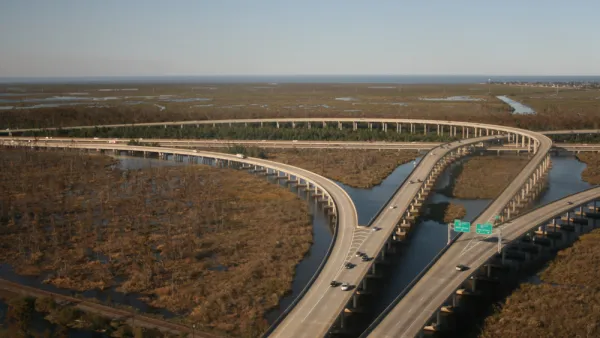
$50 Billion Coastal Master Plan Updated in Louisiana
Louisiana is losing coastal lands, quickly, along with the habitat and economic resources located there. A Coastal Master Plan plots $50 billion in spending to protect the coast.
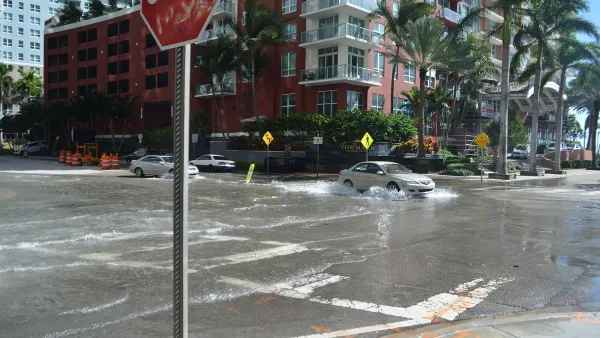
Florida Home Insurance Prices Increasingly a Burden for Residents
Climate change is coming for the state of Florida, and it’s already showing up in the insurance market.
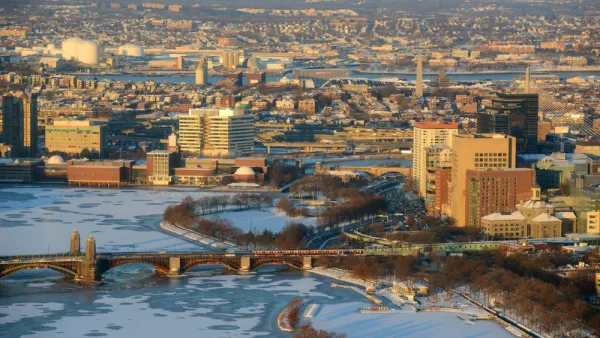
Tracking Boston’s Emissions Reduction Progress
The Boston Foundation published the “Inaugural Boston Climate Progress Report” earlier this month. Other U.S. cities should follow their lead.

Planetizen Federal Action Tracker
A weekly monitor of how Trump’s orders and actions are impacting planners and planning in America.

Eastern Nebraska is running out of electricity
Data centers and electrification are straining eastern Nebraska’s grid, throttling economic development.

Washington state to charge fee to drivers with fuel-efficient cars
Revenue from the fee will go towards supporting the state’s highways.

Instead of building new housing, LA developers are turning mansions into mega-mansions
In the richest areas, the number of houses valued at $30 million with demolition permits has skyrocketed since 2018.

Illinois considers spending $1 billion in taxpayer money on data center
A quantum computing campus and data center are currently under construction in Chicago.

As development costs rise, Boston moves to lessen affordable housing requirements
The Boston Zoning Commission and the City Council still need to approve Boston Mayor Michelle Wu’s proposed changes

FREE Course: Walkable City 1: Why Walkability?
After describing his path towards focusing on walkability as the essence of good planning, Jeff Speck marches through his five principal reasons for making more walkable places.
Reinventing Malls: Planning Alchemy—Turning Gray Fields Into Gold
The course focuses on the opportunities and imperatives that shape reinvention of mall sites.

City of Charlotte
City of Rosemead
Rutgers University, Edward J. Bloustein School of Planning and Public Policy
University of Michigan School for Environment and Sustainability (SEAS)
Hunter College, City University of New York (CUNY)
The Architects Foundation
University District Partnership
City of Cambridge
The Pocatello Development Authority