The new, privately financed Chase Center arena was designed with San Francisco's tech wealth in mind. It's a handsome addition to the Mission Bay neighborhood but pulls the Bay Area further away from its blue collar roots.


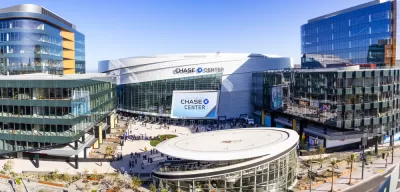
"The team settled on an 11-acre site in the Mission Bay neighborhood of San Francisco, one of the only major underdeveloped parcels remaining near the famously dense and expensive downtown. A former rail yard and industrial district, Mission Bay was created largely with landfill, including refuse from the 1906 earthquake. The site offers views across the bay of the old arena and, more importantly, of the east span of the Bay Bridge, which adorns the team’s logo. It is one of the more spectacular settings in the American sports landscape—rivaled only by Oracle Park, the Giants’ baseball stadium about a half-mile to the north."
"The center’s most appealing exterior feature may be an entry plaza—roughly the size of two basketball courts—framed on the east side by a glass pavilion housing an amphitheater (designed by SHoP) and on the west by the arena itself and an enormous video screen mounted to the building’s façade. A public walkway encircles the entire drum, sloping downward from the entry plaza through an appealing box-canyon-like passage on the south side and through a paseo lined with restaurants and the NBA’s largest team store on the north side. A series of stairs and plazas on the east side overlook the bay."
FULL STORY: Luxury (and Layups) at the Chase Center

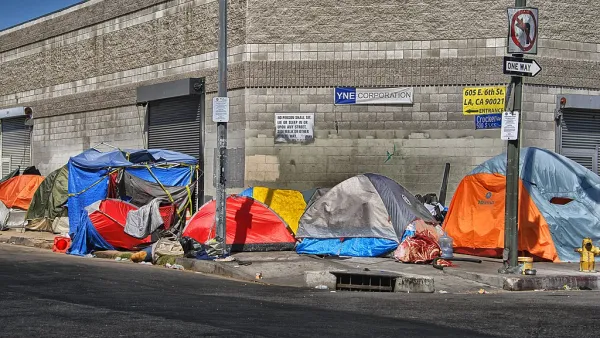
Homelessness Fuels a Backlash in California
The Golden State's ongoing homelessness crisis has residents on edge and is testing the limits of empathy in a state known for its liberal values.
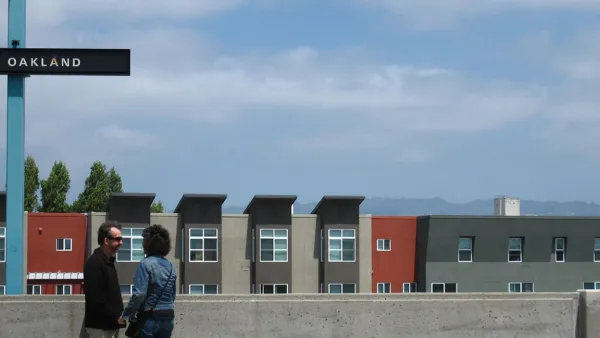
Gentrification and Race in the San Francisco Bay Area
A feature article revisits the gentrification and displacement discussion, especially as it pertains to racial and economic demographics, in one of the nation's most troubled and challenging housing markets.
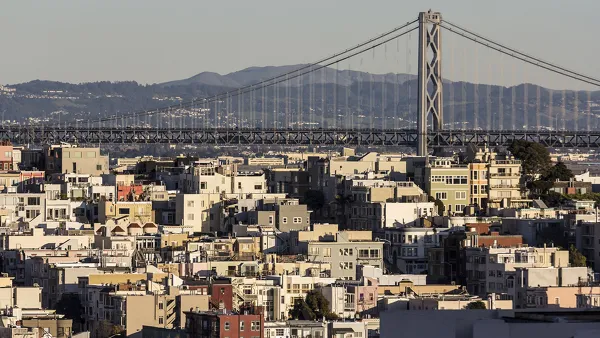
Bay Area Planners Acknowledge the Need for Regional Housing Solutions
While most Bay Area communities are pursuing housing solutions "individually," local planners acknowledge the need for strategies that address the regional as a unified whole.

Planetizen Federal Action Tracker
A weekly monitor of how Trump’s orders and actions are impacting planners and planning in America.

The state-sanctioned urbicide of Austin
People don’t kill cities. Freeways do.

US to reduce Colorado River water deliveries to Mexico
A new Colorado Treaty amendment reduces Mexico’s Colorado River water allocation by 250,000 acre feet.

5 New England states march closer to 800 megawatt wind energy project
Securing federal approval for the project may be complicated under the Trump administration, which has historically been hostile towards domestic wind power.

Baltimore to break ground on $50 million Transit Priority Project
The project will bring faster bus trips, safer streets and better bike connections to Baltimore.

Airbnb launches $250 million 'last-dollar financing' housing accelerator, makes first investment in Austin
The company will put $6.4 million towards affordable housing development in Texas’ capital.

FREE Course: Walkable City 1: Why Walkability?
After describing his path towards focusing on walkability as the essence of good planning, Jeff Speck marches through his five principal reasons for making more walkable places.
Reinventing Malls: Planning Alchemy—Turning Gray Fields Into Gold
The course focuses on the opportunities and imperatives that shape reinvention of mall sites.

Eagle County Government
Harvard University Graduate School of Design
Nashville Planning Department
The Architects Foundation
University of Cincinnati Online
The Pocatello Development Authority
The Urban Renewal Agency of the City of Pocatello
Journal of the American Planning Association