The culture war episode sparked by a recent commercial aired on the Hallmark Movies & Mysteries Channel shouldn't surprise anyone who has noticed the anti-urban themes consistent in the channel's Christmas movies.



Columnist Jeb Lund has noticed a theme among the many examples of the Hallmark Movies & Mysteries Channel (commonly referred to as the Hallmark Channel):
The world of Hallmark often resembles a kind of rear-guard action in a culture war that the network’s prime demographic is losing. The jobs, homes, community and security in the bleached pastoral hamlets showcased in the Hallmark universe are dwindling, increasingly as unreal as their TV presentation.
The channel's original program amounts to a Normal Rockwell take on Christmas, according to Lund. That vision of the United States is also obviously anti-metropolitan.
Hallmark’s movies are stridently anti-metropolitan, almost always beginning with a heroine fleeing the city on some pretext or another. The geography of her personal rescue takes the form of small towns and pastoral settings, where everyone has a nice house and a car and is probably a small-business owner or about to improve themselves by becoming one.
The culture war did not end with the "skirmish" surrounding the lesbian kiss depicted in a commercial aired on the channel, argues Lund, and the political choices that motivate programming choices like Hallmark's come with social costs.
Read the full story: Hallmark’s Christmas movies are part of a culture war their viewers are losing

Minnesota’s Joyful ‘Holiday Train’ Begins its Annual Cross-state Journey
The brightly decorated train makes 21 stops, hosting live music events in cities it visits.
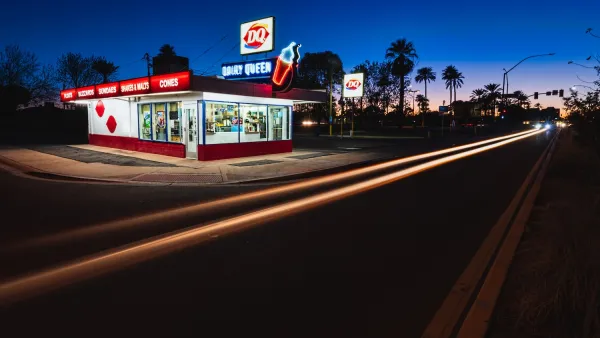
Dairy Queen and Rural Third Places
Dozens of Dairy Queen restaurants across Texas are closing, taking a critical community space with them.

Midburbs: A New Definition of Suburbs
When the name “suburb” just doesn't quite fit.

Planetizen Federal Action Tracker
A weekly monitor of how Trump’s orders and actions are impacting planners and planning in America.

California plans to bury El Niño’s downpour
If the state plays its cards right, it may be able to store a billion acre-feet of El Niño’s water in aquifers.

Desperate measures: Advocates weigh draining Lake Powell to fill Colorado River
Draining the reservoir could reduce evaporation losses by a couple hundred thousand acre-feet.

Mamdani’s pied-à-terre tax survives legal challenge
A panel of judges found that the plaintiffs failed to demonstrate injury as a result of New York City's implementation of the tax.

Eastern Nebraska is running out of electricity
Data centers and electrification are straining eastern Nebraska’s grid, throttling economic development.

Seattle passes record-breaking transit services expansion
Proposition 1 will double the city’s transit tax to add 95,000 more bus trips and preserve 180,000 bus trips annually.

FREE Course: Walkable City 1: Why Walkability?
After describing his path towards focusing on walkability as the essence of good planning, Jeff Speck marches through his five principal reasons for making more walkable places.
Reinventing Malls: Planning Alchemy—Turning Gray Fields Into Gold
The course focuses on the opportunities and imperatives that shape reinvention of mall sites.

City of Rosemead
Rutgers University, Edward J. Bloustein School of Planning and Public Policy
One Hundred Miles
University of Michigan School for Environment and Sustainability (SEAS)
Hunter College, City University of New York (CUNY)
The Architects Foundation
City of Cambridge
Montrose County
The Pocatello Development Authority