The 1931 Beaux-Arts Ball immortalized the architects who participated by dressed like famous buildings. Will a 2019 version of the event achieve a contemporary version of the same fame?


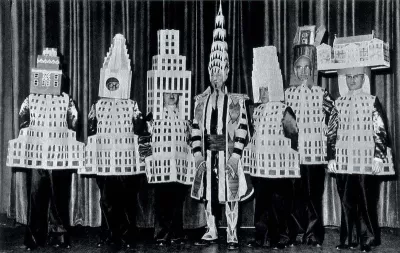
Blair Kamin reports: "Evoking a celebrated 1930s ball where architects dressed as likenesses of their skyscrapers, a Chicago-based group reprised the event Wednesday night, holding a costume contest that was won by an outfit that turned Malaysia’s Petronas Twin Towers into back-to-the-future jetpacks."
The event was hosted by the Council on Tall Buildings and Urban Habitat, which also recently released its list of 50 most influential buildings of the last 50 years.
"The event was calculated to elicit comparisons with the 1931 Beaux-Arts Ball, which was held in New York City and is still remembered for a photograph of seven architects dressed as their buildings. The star of that group was William Van Alen, architect of the Chrysler Building, who wore a crown of sunbursts like those on his Art Deco skyscraper as well as a Buck Rogers-style cloak and boots," according to Kamin.
Kamin has the photos and the archive to draw out interesting comparisons between the seven finalists in the contest in 1931 and the seven finalists in 2019. One big difference: there were women on the stage this time around.


A Planner's Halloween: Unsafe Streets, Haunted Cities, and Clever Costumes
This year's top Halloween costume: a public service announcement to drive safely on Halloween.
7 Costumes for the Most Contemporary Form of Transportation: Hoverboards
Depending on your opinion, hoverboards are some combination of expensive, annoying, or futuristically cool. Maybe these costume ideas will help you sort out your feelings on the matter?
How to Pick the Perfect Urbanist Halloween Costume
The editors at CityLab got creative in conjuring up some urbanism-themed costume ideas. They'll even help you decide which works for you.

The state-sanctioned urbicide of Austin
People don’t kill cities. Freeways do.

US to reduce Colorado River water deliveries to Mexico
A new Colorado Treaty amendment reduces Mexico’s Colorado River water allocation by 250,000 acre feet.

New Jersey’s second-largest city bans standalone data centers
Jersey City will continue to allow co-location facilities, such as those meant for research institutions that store their own data.

Amtrak not solely to blame for New Jersey commuter rail's unreliability, report finds
A new study from the Garden State Initiative found that NJ Transit’s budget grew 20% across a 4 year period, but reliability declined significantly over the same period.

EPA erases limits on planet-warming pollution from power plants
Under Monday’s plan, power plants would still have some limits on how much mercury, arsenic and other contaminants they can emit.

Phoenix announces new on-demand transit service, more frequent RAPID buses
Both new services will launch in October, and are part of Phoenix's Project Effective Access Solutions for Easing Congestion.

FREE Course: Walkable City 1: Why Walkability?
After describing his path towards focusing on walkability as the essence of good planning, Jeff Speck marches through his five principal reasons for making more walkable places.
Reinventing Malls: Planning Alchemy—Turning Gray Fields Into Gold
The course focuses on the opportunities and imperatives that shape reinvention of mall sites.

Eagle County Government
Harvard University Graduate School of Design
Nashville Planning Department
The Architects Foundation
University of Cincinnati Online
The Pocatello Development Authority
The Urban Renewal Agency of the City of Pocatello
Journal of the American Planning Association