In sharp contrast to France's yellow vest demonstrations against fuel tax hikes, Madrid residents took to the streets to keep them free of motor vehicles after new leaders were elected who vowed to rescind the driving ban enacted last November.


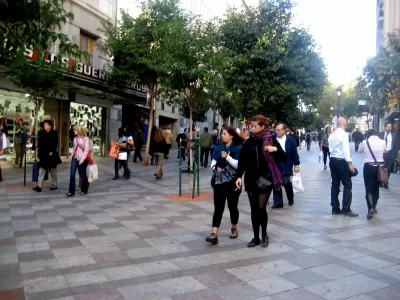
"When the city’s current center-right/right/extreme-right coalition came to power following May 26 elections, one of its first promises was to scrap the laws that had seen almost all private cars disappear from inner Madrid—not just from side streets, but from major roads, too," reports Feargus O'Sullivan for CityLab. That campaign promise has been put on hold, "and it’s likely [to] be abandoned for good."
As CityLab previously reported [via Planetizen], Madrid’s new mayor José Luis Martinez-Alameda announced that repealing the car ban was a priority. Isabel Diaz-Ayuso, the new president of the Madrid region (akin to a state governor), went so far as to declare that late-night traffic jams were part of the city’s identity.
The driving ban, with an exception for zero-emission vehicles, applies to a low-emission zone called Madrid Central. Note the emissions-based restrictions placed on motorcycles and light-duty vehicles owned by residents in the Residential Priority Area which took effect November 30, 2018, enacted by Madrid’s outgoing left-wing mayor, Manuela Carmena.
O'Sullivan reported earlier that surveys showed that driving bans were popular with the public and that the national government had plans to enact similar bans "in more than 100 other places."
With the new coalition leading city government and Mayor Martinez-Alameda taking office on June 15, public health and environmental advocates feared that the repeal would be the "first domino in a chain of anti-green backlashes that would see car bans start to collapse across Europe," adds O'Sullivan, but then the people made their displeasure known.
Thousands took to the streets at the end of June to protest the about-face—10,000 people according to the Madrid state government, 60,000 according to organizers—something that has previously never happened so soon in the term of any Madrid mayor.
Along with the march came critical coverage in the New York Times—a significant, chastening step for an administration which, regardless of who’s in power, is rarely discussed in much detail outside Spain.
Raphael Minder, the Spain and Portugal correspondent for The New York Times, noted the importance of Spain belonging to the European Union in his July 1 article as being a factor in the debate on the driving ban in the low-emissions zone known as Central Madrid.
Environmental experts now warn that the Spanish authorities could soon face a fine from Brussels [the principal seat of the EU] for not meeting stringent emissions-reducing targets laid out at the European level.
“When you look at this policy reversal over pollution in Madrid, it’s clear that there is no real green conscience in Spain,” said Lola Leirado, an activist representing Equo, the country’s main environmental party. “The only thing that saves us is that Spain is part of the European Union and environmental policy is increasingly decided in Brussels which means cities have to respect European rules — whatever their mayors believe.”
Legal as well as popular support for driving ban
In addition to public demonstrations to retain the driving ban, "two further court judgments have ruled in favor of retaining the car ban as a public health protection," adds O'Sullivan. "It’s hard to think of a municipal measure more roundly and swiftly defeated on so many fronts."
Minder, the Times correspondent, reported on a local court decision by Judge Jesús Torres Martínez that forced the new mayor to rescind his three-month order to stop fining motorists who violated the driving ban while his administration "studied other ways to combine car traffic with efforts to improve air quality."
[I]n a local court ruling issued on [July 5], less than a week after the fines stopped, Judge Jesús Torres Martínez ruled that the Madrid Central system was “essential” in order “to improve the quality of the air that the citizens of Madrid breathe, which has a direct impact on health.”
However, the measure to rescind the ban has not entirely been defeated. Martinez-Alameda is appealing the court ruling, but O'Sullivan writes it will be difficult for the mayor to succeed. "Car bans like Madrid’s offer clear, tangible improvements to citizens’ health and quality of life, and have largely gained the popular support needed to make them sustainable long-term."
Related in Planetizen:
-
Madrid’s Bold Car Ban May Become a Thing of the Past, June 24, 2019
-
Car Ban in Madrid Boosted Retail Sales, Study Shows, March 16, 2019
FULL STORY: In Madrid, a Car Ban Proves Stronger Than Partisan Politics

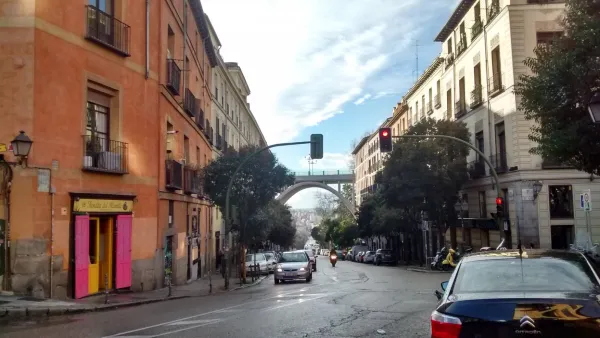
Madrid’s Bold Car Ban May Become a Thing of the Past
A new conservative administration says it wants to do away with the ban on cars in the city center.

Madrid Takes Drastic Action to Curb Pollution
With a growing reputation for heavy local pollution, the city of Madrid will impose reduced speed limits and driving restrictions in its central core. On bad days, transit will be free to ride.
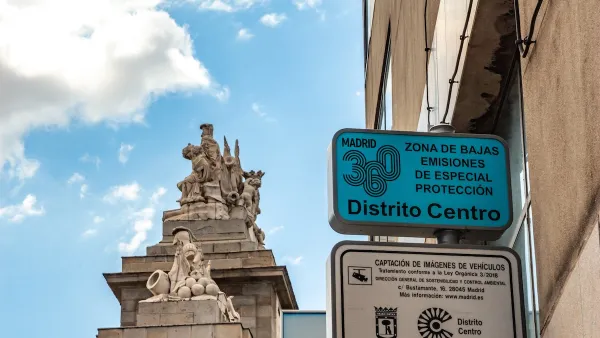
Madrid Uses Transit System for Parcel Delivery to Cut Emissions
A new pilot program uses trains to deliver packages at off-peak hours, lowering emissions from trucks.

Planetizen Federal Action Tracker
A weekly monitor of how Trump’s orders and actions are impacting planners and planning in America.

The state-sanctioned urbicide of Austin
People don’t kill cities. Freeways do.

US to reduce Colorado River water deliveries to Mexico
A new Colorado Treaty amendment reduces Mexico’s Colorado River water allocation by 250,000 acre feet.

5 New England states march closer to 800 megawatt wind energy project
Securing federal approval for the project may be complicated under the Trump administration, which has historically been hostile towards domestic wind power.

Baltimore to break ground on $50 million Transit Priority Project
The project will bring faster bus trips, safer streets and better bike connections to Baltimore.

Airbnb launches $250 million 'last-dollar financing' housing accelerator, makes first investment in Austin
The company will put $6.4 million towards affordable housing development in Texas’ capital.

FREE Course: Walkable City 1: Why Walkability?
After describing his path towards focusing on walkability as the essence of good planning, Jeff Speck marches through his five principal reasons for making more walkable places.
Reinventing Malls: Planning Alchemy—Turning Gray Fields Into Gold
The course focuses on the opportunities and imperatives that shape reinvention of mall sites.

Eagle County Government
Harvard University Graduate School of Design
Nashville Planning Department
The Architects Foundation
University of Cincinnati Online
The Pocatello Development Authority
The Urban Renewal Agency of the City of Pocatello
Journal of the American Planning Association