A unanimous ruling by a three-judge panel of the U.S. Sixth Circuit Court of Appeals on April 22 found that the chalking of tires by parking enforcement officers on public streets is a violation of the Fourth Amendment.


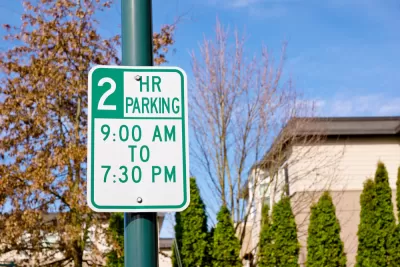
"Chalking violates the Fourth Amendment’s ban on unreasonable searches and seizures, the Sixth Circuit Court of Appeals judges said, reversing a lower court’s decision to dismiss the suit and sending it back for trial instead," reports Campbell Robertson for The New York Times.
CNN: At 1:15 minutes, Michael Smerconish asks the plaintiff's attorney how chalking constitutes a "search."
Two clever lawyers in Saginaw, Mich., saw a connection between chalking tires and a 2012 Supreme Court decision, United States v. Jones, which involved a GPS tracker that the police had secretly attached to Antoine Jones' car without obtaining a valid warrant, explains Robertson.
... Justice Antonin Scalia, writing for the five-justice majority, held that the heart of the matter was the physical placement of a device on Mr. Jones’s “private property, for the purpose of obtaining information.” It was this “government trespass,” he wrote, that made the use of the tracker without a warrant an unconstitutional search.
The Saginaw case, "Alison Patricia Taylor, Plaintiff-Appellant vs. City of Saginaw; Tabetha Hoskins, Defendants-Appellees [pdf]," was initially heard on April 5, 2017, by the U.S. District Court for the Eastern District of Michigan in Bay City. Appeals court Judge Bernice Donald wrote for the panel, surprisingly showing some humor in the use of a pun:
Alison Taylor, a frequent recipient of parking tickets, sued the City and its parking enforcement officer Tabitha Hoskins, alleging that chalking violated her Fourth Amendment right to be free from unreasonable search. The City moved to dismiss the action. The district court granted the City’s motion, finding that, while chalking may have constituted a search under the Fourth Amendment, the search was reasonable.
Because we chalk this practice up to a regulatory exercise, rather than a community-caretaking function, we REVERSE.
The 10-page court decision answers two questions: Does chalking constitute "a search within the meaning of the Fourth Amendment; and second, whether the search was reasonable."
"Among other legal rationales, the [trial] judge found that the police have the authority to enforce parking regulations, even to tow cars, as an exercise of “community caretaking," writes Robertson.
The Sixth Circuit judges disagreed, finding that the enforcement of a two-hour parking limit was not a matter of public safety, but simply a way of raising revenue. Nor, they said, was there any probable cause to justify the search, since the chalk marks are made on cars that, at that time, are still legally parked.
This correspondent finds some irony in basing the appeal on the Jones case as chalking couldn't be more different than employing GPS technology. As the plaintiff herself noted, "There should be a better way to track this, ... What if it’s raining one day?”
Possible implications for "free parking"
No doubt more modern methods utilizing technology will be considered in lieu of chalk, as UCLA urban planning Professor Donald Shoup told Robertson.
Though officers these days may also take time-stamped photographs to document the infraction, “chalking tires is very old-fashioned,” said Shoup. “The first references I’ve seen to it were in the 1920s.”
Every city with a parking ordinance probably used chalking at one time, Professor Shoup said, but the practice is becoming less common, replaced by computerized meters, pay-by-phone apps and digital vehicle recognition systems, including one called autoChalk.
However, it should be noted that the first two methods Shoup mentioned apply to priced parking.
Alison Taylor, the plaintiff who worked at a local newspaper, chose to park on the street or a public lot where parking was unmetered but limited to two hours, as opposed to an all-day lot, also unpriced, reports Matthew S. Schwartz for NPR.
"We don't think everyone deserves free parking," Taylor's lawyer, Philip Ellison, told The Associated Press. "But the process Saginaw selected is unconstitutional. ... I'm very glad the three judges who got this case took it seriously. It affects so many people."
Had street parking been metered, it is possible that Ms. Hoskins and other parking enforcement officers would need only check the meters or pay stations to see if violations had occurred. This nexus of chalking to unpriced parking was noted by Suzanne Maxwell, director of the Bay City Downtown Development Authority, where the trial court is located. Robertson of the Times writes:
Bay City is working on an alternative to chalking, said Maxwell, but in the meantime, it has no procedure for enforcing time limits in free spots downtown.
"It is unclear what will happen now in the wake of the decision, which is binding in the four states covered by the Sixth Circuit — Michigan, Ohio, Kentucky and Tennessee," adds Robertson.
Hat tip to Michael Smerconish (CNN).
FULL STORY: Lose the Chalk, Officer: Court Finds Marking Tires of Parked Cars Unconstitutional

U.S. Supreme Court Upholds New York State Vaccine Mandate
Health care workers in New York will be required to be vaccinated against COVID-19 after the Supreme Court voted 6-3 to reject hearing an appeal brought by workers who had sought a religious exemption. Also, an update on the federal vaccine mandate.

Coronavirus Litigation: CDC Loses Ability to Regulate Cruise Industry in Win for Florida Governor
In a stunning reversal, a federal appeals court panel on July 23 reversed its ruling issued six days earlier in favor of the Centers for Disease Control and Prevention after Gov. Ron DeSantis appealed the ruling to the Supreme Court.

Dakota Access Pipeline Owners Win Eminent Domain Appeal in Iowa Supreme Court
The Iowa Supreme Court affirmed a lower court ruling that found that the Iowa Utilities Board was justified in giving the private owners of the Dakota Access Pipeline the use of eminent domain. Climate change was considered in the ruling.

The state-sanctioned urbicide of Austin
People don’t kill cities. Freeways do.

US to reduce Colorado River water deliveries to Mexico
A new Colorado Treaty amendment reduces Mexico’s Colorado River water allocation by 250,000 acre feet.

New Jersey’s second-largest city bans standalone data centers
Jersey City will continue to allow co-location facilities, such as those meant for research institutions that store their own data.

Amtrak not solely to blame for New Jersey commuter rail's unreliability, report finds
A new study from the Garden State Initiative found that NJ Transit’s budget grew 20% across a 4 year period, but reliability declined significantly over the same period.

EPA erases limits on planet-warming pollution from power plants
Under Monday’s plan, power plants would still have some limits on how much mercury, arsenic and other contaminants they can emit.

Phoenix announces new on-demand transit service, more frequent RAPID buses
Both new services will launch in October, and are part of Phoenix's Project Effective Access Solutions for Easing Congestion.

FREE Course: Walkable City 1: Why Walkability?
After describing his path towards focusing on walkability as the essence of good planning, Jeff Speck marches through his five principal reasons for making more walkable places.
Reinventing Malls: Planning Alchemy—Turning Gray Fields Into Gold
The course focuses on the opportunities and imperatives that shape reinvention of mall sites.

Eagle County Government
Harvard University Graduate School of Design
Nashville Planning Department
The Architects Foundation
University of Cincinnati Online
The Pocatello Development Authority
The Urban Renewal Agency of the City of Pocatello
Journal of the American Planning Association