The St. Paul Planning Commission will consider 32 proposed amendments to the Master Plan for a massive development project located at the former site of a Ford assembly plant.


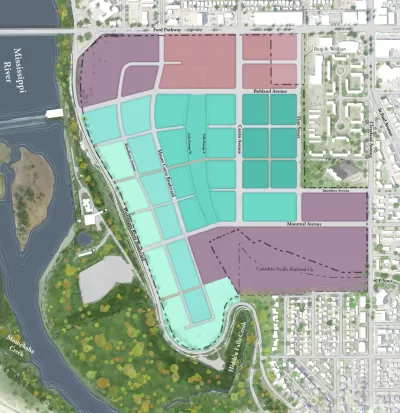
The developer of massive planned development at the former Ford site in Highland Park, St. Paul is seeking 32 amendments to a Master Plan approved in 2017.
"The 122-acre property is expected to be home to 3,800 proposed housing units, civic space, office and retail buildings," report Frederick Melo.
Minneapolis-based Ryan Cos., chosen as the master developer last summer, has proposed some controversial changes to the Master Plan.
According to Melo, instead of the multiple-unit homes of two to six dwellings per structure on Mississippi River Boulevard as proposed by the Master Plan, Ryan officials "have asked to be allowed to construct 35 single-family homes, with the intent of creating a more 'diverse blend of housing types and affordability levels.'"
"Public feedback has been mixed, with some neighborhood residents praising the idea and others calling it an about-face on Ryan’s commitment to housing density and affordability," according to Melo.
For more background on the land use and urban design ambitions of the planned development, see another article by Melo from October 2018.
Read the full story: St. Paul planning commission to consider amendments to Ryan Cos. plans for Ford site
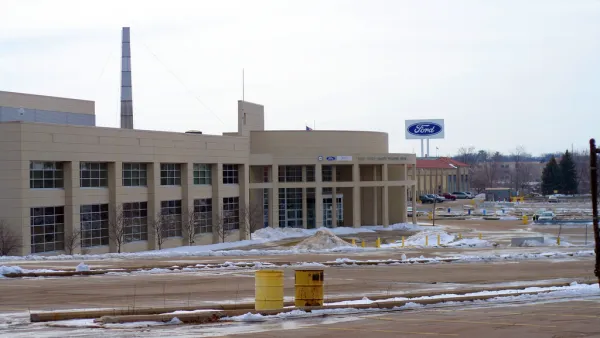
Controversial Green Neighborhood to Rise on Former Auto Plant Site
Plans for a sizable eco-friendly development on the site of St. Paul's Twin Cities Assembly Plant have drawn support from many, including the city's young mayor. But density opponents remain unconvinced.
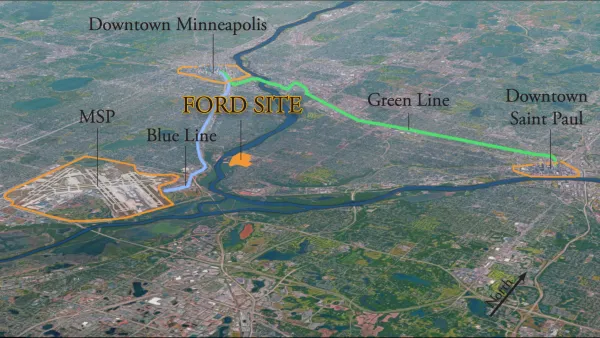
Former Ford Plant in St. Paul Taking Shape as a Massive Mixed-Use Development
A long-awaited plan for the former Ford plant along the Mississippi River is now open for public comment.

Looking Back on 60 Years of Land Development in the Twin Cities
In 1960, about 12 percent of the Twin Cities metro's land was already developed. By 2020, about 34 percent had been developed. Many factors influenced how the region has changed since 1960.

Planetizen Federal Action Tracker
A weekly monitor of how Trump’s orders and actions are impacting planners and planning in America.

California plans to bury El Niño’s downpour
If the state plays its cards right, it may be able to store a billion acre-feet of El Niño’s water in aquifers.

Desperate measures: Advocates weigh draining Lake Powell to fill Colorado River
Draining the reservoir could reduce evaporation losses by a couple hundred thousand acre-feet.

Mamdani’s pied-à-terre tax survives legal challenge
A panel of judges found that the plaintiffs failed to demonstrate injury as a result of New York City's implementation of the tax.

Eastern Nebraska is running out of electricity
Data centers and electrification are straining eastern Nebraska’s grid, throttling economic development.

Seattle passes record-breaking transit services expansion
Proposition 1 will double the city’s transit tax to add 95,000 more bus trips and preserve 180,000 bus trips annually.

FREE Course: Walkable City 1: Why Walkability?
After describing his path towards focusing on walkability as the essence of good planning, Jeff Speck marches through his five principal reasons for making more walkable places.
Reinventing Malls: Planning Alchemy—Turning Gray Fields Into Gold
The course focuses on the opportunities and imperatives that shape reinvention of mall sites.

City of Rosemead
Rutgers University, Edward J. Bloustein School of Planning and Public Policy
One Hundred Miles
Hunter College, City University of New York (CUNY)
The Architects Foundation
University of Cincinnati Online
City of Cambridge
Montrose County
The Pocatello Development Authority