When gentrification takes center stage, neglected places facing poverty, segregation, and disinvestment are overlooked.


Jason Segedy, planning director of Akron, Ohio, considers the decline of American cities by reflecting on Alan Mallach's book The Divided City. Segedy says that much of the focus is on revitalization when it should be on “displacement by decline.”
Activists and academics often point to the impacts of gentrification, even when its meaning is not entirely clear any longer, says Segedy. "We hear far less about the primarily black middle class residents fleeing previously stable urban neighborhoods for the suburbs each year (displacement by decline), while the poor are left behind in crumbling communities, trapped in concentrated generational poverty."
In thinking about how to move forward, Segedy again draws from Mallach. "In order to become effective change agents, Mallach argues that city leaders must step back from daily crises, difficult as that sometimes is, and think about systemic issues and power structures in their communities." Segedy adds that change needs to happen at the local level, without expectations that the federal government will provide the solutions.
He also is critical of responses across the political spectrum, nothing that the right has demonstrated little interest in the future of cities. "The political left, meanwhile, spellbound by the Dada performance art that bills itself as 'The Resistance' in this absurd age of Trump, staggers drunkenly between a wonky and bloodless urbanism, and an increasingly strident and unhinged leftism."
See also: Segedy's review of The Divided City from July 2018.
FULL STORY: Displacement by decline

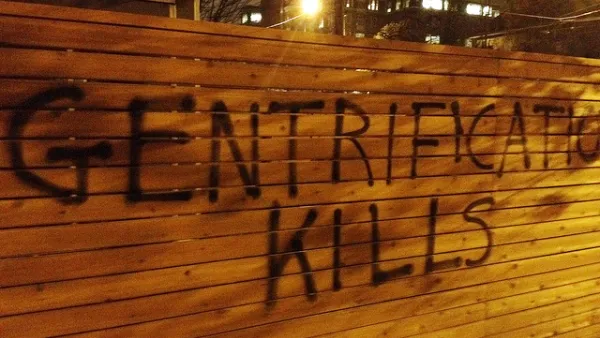
What We Really Mean When We Say Gentrification
The focus on gentrifying communities has, in many cases, eclipsed the similar problems facing more stagnant neighborhoods.
Census Data: Black Americans Leaving Cities for Suburbs
The trend of Black Americans leaving urban areas for suburban communities mirrors the White Flight of the mid-20th century but for vastly different reasons and with vastly different consequences.
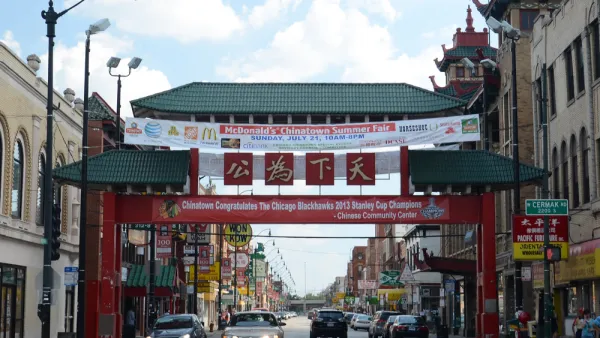
In Defense of Asian American Neighborhoods
How do you address a history of anti-Asian housing discrimination? Not by destroying Asian American communities.

The state-sanctioned urbicide of Austin
People don’t kill cities. Freeways do.

US to reduce Colorado River water deliveries to Mexico
A new Colorado Treaty amendment reduces Mexico’s Colorado River water allocation by 250,000 acre feet.

New Jersey’s second-largest city bans standalone data centers
Jersey City will continue to allow co-location facilities, such as those meant for research institutions that store their own data.

Amtrak not solely to blame for New Jersey commuter rail's unreliability, report finds
A new study from the Garden State Initiative found that NJ Transit’s budget grew 20% across a 4 year period, but reliability declined significantly over the same period.

EPA erases limits on planet-warming pollution from power plants
Under Monday’s plan, power plants would still have some limits on how much mercury, arsenic and other contaminants they can emit.

Phoenix announces new on-demand transit service, more frequent RAPID buses
Both new services will launch in October, and are part of Phoenix's Project Effective Access Solutions for Easing Congestion.

FREE Course: Walkable City 1: Why Walkability?
After describing his path towards focusing on walkability as the essence of good planning, Jeff Speck marches through his five principal reasons for making more walkable places.
Reinventing Malls: Planning Alchemy—Turning Gray Fields Into Gold
The course focuses on the opportunities and imperatives that shape reinvention of mall sites.


Eagle County Government
Harvard University Graduate School of Design
Nashville Planning Department
The Architects Foundation
University of Cincinnati Online
The Pocatello Development Authority
The Urban Renewal Agency of the City of Pocatello
Journal of the American Planning Association