A rail transit project has serious momentum in Los Angeles, offering a potentially game changing alternative to the notoriously jammed commute on Interstate 405 over the Sepulveda Pass.


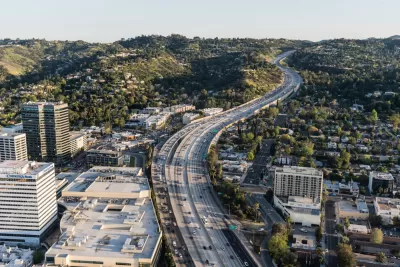
The Los Angeles County Metropolitan Transportation Authority (Metro) yesterday announced refined plans to built a rail transit connection between the Westside and the San Fernando Valley in Los Angeles. The notoriously jammed Interstate 405 Freeway now serves as the route's primary connection.
Writing for Metro, Steve Hymon presents the four "refined concepts" released yesterday, describing the planned route as "fast, high capacity rail."
"The refined concepts are part of an ongoing Feasibility Study for the Sepulveda Transit Corridor project, which has nearly $10 billion in funding from Metro’s Measure R and M sales tax measures approved by L.A. County voters in 2008 and 2016, respectively," explains Hymon.
Hymon points out additional details included in the current presentation of the refined concepts. A few to note include a proposal to remove light rail from consideration, due to its lower carrying capacity, in favor of heavy rail.
Other large questions still need to be resolved about how to connect the Sepulveda Transit Corridor to the planned East San Fernando Valley Transit Corridor, a light rail route expected to begin construction in 2022.
Local media was quick to pick up the news. Steven Sharp, writing for Urbanize LA, provides details on the four alternatives under consideration.
Laura Nelson also reports on the new concepts for the project, noting the engineering challenges posed by the steep hills of the Sepulveda Pass. Still, notes Nelson, the project offers a "key opportunity to shift more drivers onto transit" in a region where the vast majority of commuters drive alone to work.
FULL STORY: Here are the four new refined concepts for Sepulveda Transit Corridor


Environmental Review for Light Rail Through The Valley Approved
The B Line subway includes two stops in the San Fernando Valley in Los Angeles, but other than that, commuter rail and buses are the only options for transit. New light rail plans could change that.
Light Rail Proposal for L.A.'s San Fernando Valley Wins Key Approval
Light rail could come to "The Valley" for the first time, under a plan approved this week by the Los Angeles County Metropolitan Transportation Authority's Board of Directors.
Funding for Two Transit Projects Approved for the Valley in Los Angeles
Local funding for a new light rail line and upgrades to the G Line (née Orange Line) bus rapid transit route have been approved for the San Fernando Valley in Los Angeles.

The state-sanctioned urbicide of Austin
People don’t kill cities. Freeways do.

US to reduce Colorado River water deliveries to Mexico
A new Colorado Treaty amendment reduces Mexico’s Colorado River water allocation by 250,000 acre feet.

New Jersey’s second-largest city bans standalone data centers
Jersey City will continue to allow co-location facilities, such as those meant for research institutions that store their own data.

Amtrak not solely to blame for New Jersey commuter rail's unreliability, report finds
A new study from the Garden State Initiative found that NJ Transit’s budget grew 20% across a 4 year period, but reliability declined significantly over the same period.

EPA erases limits on planet-warming pollution from power plants
Under Monday’s plan, power plants would still have some limits on how much mercury, arsenic and other contaminants they can emit.

Phoenix announces new on-demand transit service, more frequent RAPID buses
Both new services will launch in October, and are part of Phoenix's Project Effective Access Solutions for Easing Congestion.

FREE Course: Walkable City 1: Why Walkability?
After describing his path towards focusing on walkability as the essence of good planning, Jeff Speck marches through his five principal reasons for making more walkable places.
Reinventing Malls: Planning Alchemy—Turning Gray Fields Into Gold
The course focuses on the opportunities and imperatives that shape reinvention of mall sites.

Eagle County Government
Harvard University Graduate School of Design
Nashville Planning Department
The Architects Foundation
University of Cincinnati Online
The Pocatello Development Authority
The Urban Renewal Agency of the City of Pocatello
Journal of the American Planning Association