More people are buying cars, even while more people are choosing to go without cars.


Bruce Schaller pens a guest column for CityLab that builds on the findings of his 2018 report: "The New Automobility."
From the title of that report it can be inferred that the report focuses on the changing nature of personal mobility. Between ride-hauling, car sharing, bike share, and electric scooters, these new options have the potential to be transformative.
But the societal benefits of this new era of transportation are still unclear. In fact, according to American Community Survey data identified by Schaller, the "ditch your car" of proponents of transportation technology are far from being realized.
Household vehicle ownership has increased in cities where Uber and Lyft are most heavily used, using 2012 (the year the companies started offering affordable everyday ride services like UberX) as the starting point. Moreover, the rate of vehicle growth substantially exceeded population growth in five of the eight cities (Boston, Los Angeles, New York, Philadelphia and Chicago).
Still, the picture is contradictory, according to Schaller:
At the same time, more urban households also have no or relatively few cars. These households are often referred to as “car-free” (no cars available to the household) or “car-light,” e.g., a working couple that owns one vehicle. (For data availability reasons, “car-light” is defined here as households with fewer vehicles than workers.)
Schaller also provides insight into how to reconcile these seemingly contradictory trends. One powerful trend sticks out: the growth of "car-rich" households, households with at least one car, is driving the overall increase in vehicle ownership. That's true for many cities, but especially Los Angeles, according to Schaller.
For more data-based analysis of the role of the automobile in contemporary U.S. society, see also a recent article by Steven Polzin titled "Transportation 2019—Looking Back, Looking Ahead."
Read the full story: In a Reversal, ‘Car-Rich’ Households Are Growing

Reports of the Automobile's Demise Have Been Greatly Exaggerated
Clearly, the American love affair with the automobile is far from over, despite lessons from the recession, dire environmental warnings, plummeting traffic safety, or the wishful thinking of tech companies.
Car Loan Defaults Have Spiked 50%. With Repossession Rates Rising, How Will Americans Get to Work?
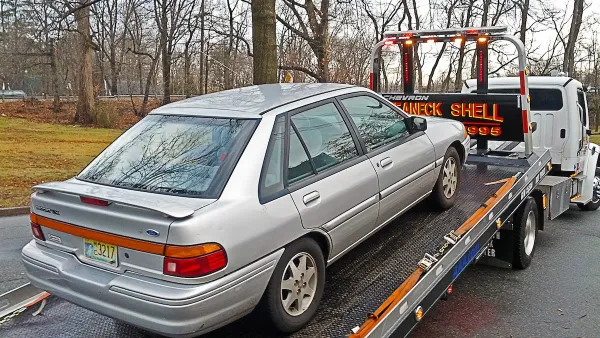
In 2024, 1.7 million cars were repossessed in the United States, the highest number since 2009.
Now 20% Car-Free, Seattle's Population is Growing. Its Traffic is Not.
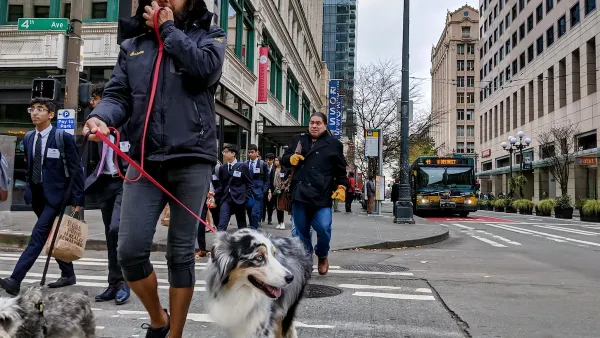
Since 2017, the number of cars in the city has stayed roughly the same, even as the population continues to grow.

Planetizen Federal Action Tracker
A weekly monitor of how Trump’s orders and actions are impacting planners and planning in America.

The state-sanctioned urbicide of Austin
People don’t kill cities. Freeways do.

US to reduce Colorado River water deliveries to Mexico
A new Colorado Treaty amendment reduces Mexico’s Colorado River water allocation by 250,000 acre feet.

Brightline West’s future may rely on $6 billion federal loan
The company has until Nov. 2 to make a $400 million equity investment into its proposed high-speed rail line.

LA Metro’s ultimatum: no extra buses for LA28 if federal funding isn’t imminently secured
If Metro does not provide additional buses, LA28 organizers will have to find a new way to manage Olympic traffic. LA28’s budget does not include a line item for transit.

Colorado’s Largest Data Center Could Rise Next to Homes — Without a Public Hearing
The proposed campus would consume 11 times the power of Denver International Airport; as it has across the country, opposition mounts.

FREE Course: Walkable City 1: Why Walkability?
After describing his path towards focusing on walkability as the essence of good planning, Jeff Speck marches through his five principal reasons for making more walkable places.
Reinventing Malls: Planning Alchemy—Turning Gray Fields Into Gold
The course focuses on the opportunities and imperatives that shape reinvention of mall sites.

Eagle County Government
Harvard University Graduate School of Design
Nashville Planning Department
The Architects Foundation
University of Cincinnati Online
The Pocatello Development Authority
The Urban Renewal Agency of the City of Pocatello
Journal of the American Planning Association