Massive projects stayed a dream in 20th century Boston. Lessons from the failed ideas of the past inform a more complete understanding of the city in the 21st century.


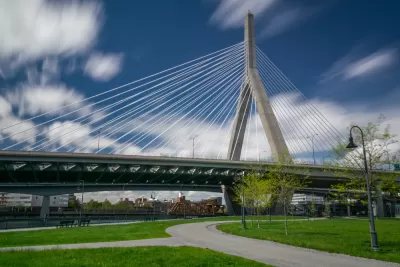
Anthony Flint takes a tour of what might have been in Boston, where there's a uniquely long history of massive projects that never got built. Flint it mining history for lessons about what separates the never built from the transformative.
Lessons considered by Flint and sources: that Bostonians are easily spooked, or that Boston has constantly sought to expand outward (by making more land, literally) or upward (history is full of failed skyscraper ideas).
Five projects are particularly informative, according to Flint:
- Inner Belt, Southwest Expressway, and Northwest Expressway (1907-1971)
- Mission Control at Kendall Square (1961-1968)
- Completion of the Emerald Necklace (1897-present)
- City Hall Plaza improvements, restoration of Hanover Street, Congress Street pedestrian bridge (circa 1965-present)
- South Boston Megaplex; football and baseball stadiums (1990-2000)
Implied in some of the discussion with reference to specific projects is that some of these projects could still be built.
For more on the "never built" or "unbuilt" trope, see previous explorations from Los Angeles, Chicago, New York, and Seattle.
Read the full story: Five plans that would’ve changed the face of Boston
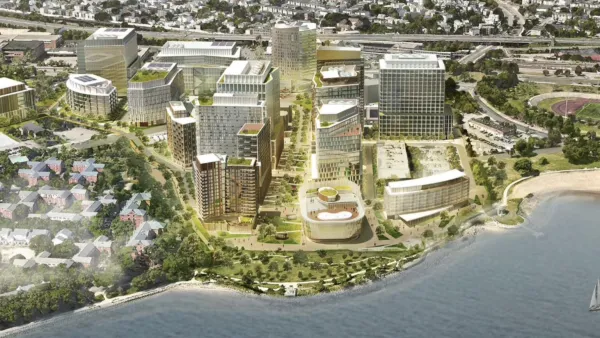
Mega-Project Aims to Transform South Boston
Developers with a ground lease for land owned by the University of Massachusetts Boston want to build a new mixed-use development to rival Kendall Square in nearby Cambridge.

Study reveals best places in the U.S. for cycling, walking
New research from Streetlight Data examines bicycle and pedestrian miles per capita in the 100 largest U.S. cities by population.
Boston is hard to build housing in: its chief of planning wants to keep it that way
Chief of Planning Kairos Shen said she would not make changes to Boston’s affordability requirements for new housing, which critics say have slowed down development.

Planetizen Federal Action Tracker
A weekly monitor of how Trump’s orders and actions are impacting planners and planning in America.

Washington state to charge fee to drivers with fuel-efficient cars
Revenue from the fee will go towards supporting the state’s highways.
Study reveals best places in the U.S. for cycling, walking
New research from Streetlight Data examines bicycle and pedestrian miles per capita in the 100 largest U.S. cities by population.

Mamdani unveils his ‘most ambitious bus lane project’ so far
The city has added two new bus lanes, which it expects to speed up tens of thousands of bus riders’ commutes.

New Jersey and New York suggest $10.3 billion budget for transit
Some of the budget is dedicated to replacing Manhattan's Midtown Bus Terminal.

States split over EPA’s proposal to drop greenhouse gas rules for power plants
The proposed rule drew over 165K comments, including from officials, health and environmental groups, and private citizens.

FREE Course: Walkable City 1: Why Walkability?
After describing his path towards focusing on walkability as the essence of good planning, Jeff Speck marches through his five principal reasons for making more walkable places.
Reinventing Malls: Planning Alchemy—Turning Gray Fields Into Gold
The course focuses on the opportunities and imperatives that shape reinvention of mall sites.

City of Charlotte
City of Rosemead
Rutgers University, Edward J. Bloustein School of Planning and Public Policy
University of Michigan School for Environment and Sustainability (SEAS)
Hunter College, City University of New York (CUNY)
The Architects Foundation
University District Partnership
City of Cambridge
The Pocatello Development Authority