Los Angeles is grappling with the rising costs of building housing for homeless people. Rethinking the standard process is a way to save time and money.


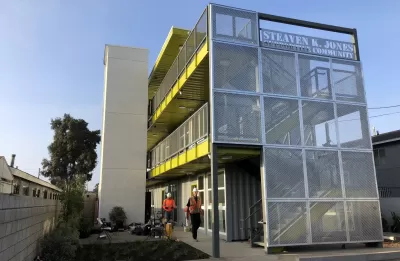
Doug Smith reports that rising construction costs are threatening to deplete Proposition HHH funds. The 2016 bond measure provides $1.2 billion to build 10,000 housing units for the homeless in 10 years. However, progress is stalling as initial expected costs of $300,000 per unit have gone up to $500,000 in recent project proposals.
The citizens' committee overseeing these funds has started looking for more innovative ways to get the housing built quickly with the funding resources available. A proposal from FlyawayHomes suggested fully funding projects through loans, rather than partially funding them, to speed up completion. It also proposed designing units with shared common areas to bring down the cost.
Another proposal from Gensler outlined a micro-units plan incorporating shared kitchens and living room spaces instead of costlier individual units. "Cristian Ahumada, executive director of nonprofit developer Clifford Beers, offered ideas including long-term leases to remove land costs from capital budgets, removing parking requirements and creating a funding model for small developments," says Smith.
The committee will continue reviewing proposals this month and offer recommendations to the city council in November.
FULL STORY: Wanted: Innovative ideas to house homeless people faster and at a lower cost

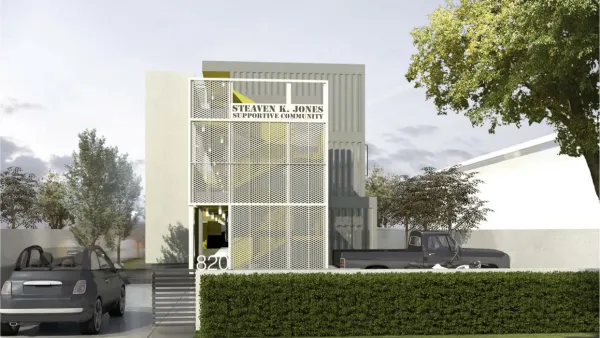
L.A. Program Seeks to Boost Construction of Homeless Housing
The Los Angeles plan to build supportive housing for homeless people is lagging and costing much more than anticipated. A new pilot program seeks to overcome these hurdles by soliciting new ideas and strategies from developers.
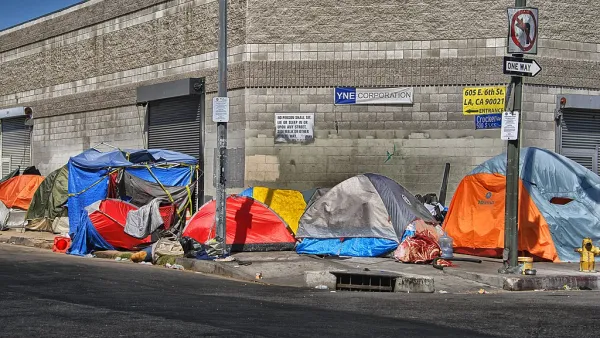
Lack of Federal and State Subsidies Slow Homeless Housing Development in L.A.
Developments funded by Los Angeles' Proposition HHH homeless housing bond has been delayed for three key reasons.
The 'Vanlord' Providing Shelter to L.A.'s Homeless
A creative rental industry has emerged in Los Angeles as the affordable housing crisis grows.

Planetizen Federal Action Tracker
A weekly monitor of how Trump’s orders and actions are impacting planners and planning in America.

The state-sanctioned urbicide of Austin
People don’t kill cities. Freeways do.

US to reduce Colorado River water deliveries to Mexico
A new Colorado Treaty amendment reduces Mexico’s Colorado River water allocation by 250,000 acre feet.

5 New England states march closer to 800 megawatt wind energy project
Securing federal approval for the project may be complicated under the Trump administration, which has historically been hostile towards domestic wind power.

Baltimore to break ground on $50 million Transit Priority Project
The project will bring faster bus trips, safer streets and better bike connections to Baltimore.

Airbnb launches $250 million 'last-dollar financing' housing accelerator, makes first investment in Austin
The company will put $6.4 million towards affordable housing development in Texas’ capital.

FREE Course: Walkable City 1: Why Walkability?
After describing his path towards focusing on walkability as the essence of good planning, Jeff Speck marches through his five principal reasons for making more walkable places.
Reinventing Malls: Planning Alchemy—Turning Gray Fields Into Gold
The course focuses on the opportunities and imperatives that shape reinvention of mall sites.

Eagle County Government
Harvard University Graduate School of Design
Nashville Planning Department
The Architects Foundation
University of Cincinnati Online
The Pocatello Development Authority
The Urban Renewal Agency of the City of Pocatello
Journal of the American Planning Association