The bills seek to end landlords' ability to offer rent discounts and then calculate increases based on the original price, rather than on what a tenant was actually paying.


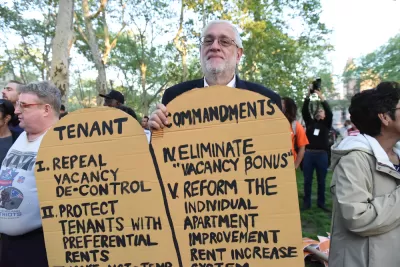
Tenants of rent-controlled units in Washington D.C. may get a reprieve from a misleading practice if the D.C. Council passes a set of new bills. Jon Steingart writes, "Councilmember Anita Bonds (D-At Large) introduced a pair of bills that would update how rent increases are determined under the city's rent control law. They target a practice called rent concessions some landlords use to offer discounts on rent, then they calculate rent increases on the non-discounted amount."
"Bonds' legislation," Steingart goes on, "would clarify that a rent adjustment should be based on the amount a tenant actually pays, rather than some higher amount a landlord says it could charge."
Bonds drew from a January decision by the city's Rental Housing Commission that rent increases should be based on "the amount actually demanded, received, or charged" by landlords. Under the new rules, landlords could still give tenants rent discounts. But adjustments would be calculated based on the discounted amount.
Given the council's legislative environment and schedule, Steingart writes that the legislation likely "faces uphill odds" of becoming law.
Read the full story: Legislation intended to end sharp rent increases lands in the DC Council


Rent Control Debated in the Nation's Capital
District council members and local tenant advocates are engaged in a bit of tug of war about how far the District should go to limit the amount landlords can raise rents.

Opinion: Rent Control Works
A dozen arguments for why rent control is effective and necessary in the current housing crisis.

More Cities Supporting Legal Counsel as a Right for All Renters
Cities, headlined by New York, are finding new ways to support renters facing eviction.

Planetizen Federal Action Tracker
A weekly monitor of how Trump’s orders and actions are impacting planners and planning in America.

California plans to bury El Niño’s downpour
If the state plays its cards right, it may be able to store a billion acre-feet of El Niño’s water in aquifers.

Chicago breaks ground on $3 billion megadevelopment
The new neighborhood, titled Foundry Park, will one day host 3,700 residences.

Satanic place names
From streams and lakes to valleys and canyons, I mapped more than 1,000 places named after the Devil.

California High-Speed Rail Authority CEO resigns after $600,000 scandal
Under Ian Choudri, the authority used taxpayer dollars to fund first class flights and trips to nightclubs.

Want to study the Missouri River? Soon, you may need unanimous approval from 10 states
Legislation would require 10 governors’ permission to study or build projects moving water outside the basin.

FREE Course: Walkable City 1: Why Walkability?
After describing his path towards focusing on walkability as the essence of good planning, Jeff Speck marches through his five principal reasons for making more walkable places.
Reinventing Malls: Planning Alchemy—Turning Gray Fields Into Gold
The course focuses on the opportunities and imperatives that shape reinvention of mall sites.

City of Rosemead
Rutgers University, Edward J. Bloustein School of Planning and Public Policy
One Hundred Miles
Hunter College, City University of New York (CUNY)
The Architects Foundation
University of Cincinnati Online
City of Cambridge
Montrose County
The Pocatello Development Authority