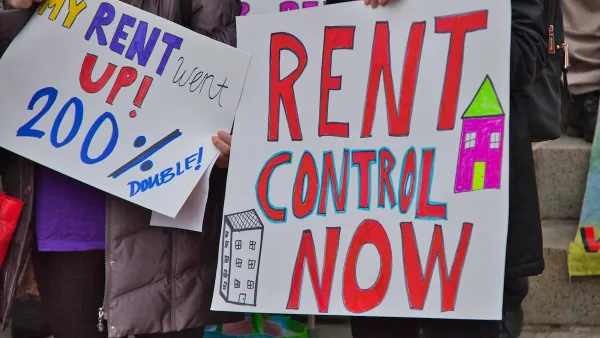
A dozen arguments for why rent control is effective and necessary in the current housing crisis.



In an article in Jacobin, Fran Quigley makes the case for rent control as a key tool for pulling the country out of the current housing crisis. “In a nation of 44 million households renting their home, rents in recent years have been rising far faster than wages and faster than overall inflation. This pattern continues a frightening trend: in the first fifteen years of the twenty-first century, median rents increased a whopping 50 percent, adjusted for inflation — even as real household incomes did not increase at all.”
Yet “Rent control opponents often disingenuously refer to rent control as a total freeze on rents, but almost all current rent control programs allow for regular rent increases, often a significant percentage plus an increase that reflects inflation.” Quigley lists a series of false claims made by the landlord lobbyist industry, then debunks them with a dozen arguments that support rent control. From providing fast relief to renters in crisis to increased household and community stability to rent control’s long history of success, Quigley describes how rent control policies help families, the economy, and society as a whole.
Meanwhile, arguments that rent control harms the housing supply have been debunked in multiple studies. In fact, “studies of rent control in New Jersey, Los Angeles, Washington DC, Boston and the Bay Area show no significant impact of rent control on construction rates.”
Quigley also points out that rent control is gaining steam in more cities and states. “At the national level, the People’s Action Homes Guarantee campaign is leading a coalition of 250 organizations calling on the Biden administration to impose rent control on all properties financed by government-backed mortgages, a measure that would apply to one of every four rental units in the country.”
FULL STORY: Why We Need Rent Control

Biden Administration Proposes Federal Rent Hike Limits
A new policy would limit rent increases to 5 percent for landlords receiving federal tax write-offs.

Boston Mayor Fights for Rent Control
Mayor Wu says putting a rent control policy in place is just one of several ways the city plans to improve housing affordability and prevent evictions, but the proposal requires state approval.

Tampa Rejects Rent Control, Citing Legal Concerns
The city council failed to move on a proposal that would have implemented rent stabilization, opting instead to explore other avenues for preventing evictions and improving the cost of housing.

The state-sanctioned urbicide of Austin
People don’t kill cities. Freeways do.

US to reduce Colorado River water deliveries to Mexico
A new Colorado Treaty amendment reduces Mexico’s Colorado River water allocation by 250,000 acre feet.

New Jersey’s second-largest city bans standalone data centers
Jersey City will continue to allow co-location facilities, such as those meant for research institutions that store their own data.

Amtrak not solely to blame for New Jersey commuter rail's unreliability, report finds
A new study from the Garden State Initiative found that NJ Transit’s budget grew 20% across a 4 year period, but reliability declined significantly over the same period.

EPA erases limits on planet-warming pollution from power plants
Under Monday’s plan, power plants would still have some limits on how much mercury, arsenic and other contaminants they can emit.

Phoenix announces new on-demand transit service, more frequent RAPID buses
Both new services will launch in October, and are part of Phoenix's Project Effective Access Solutions for Easing Congestion.

FREE Course: Walkable City 1: Why Walkability?
After describing his path towards focusing on walkability as the essence of good planning, Jeff Speck marches through his five principal reasons for making more walkable places.
Reinventing Malls: Planning Alchemy—Turning Gray Fields Into Gold
The course focuses on the opportunities and imperatives that shape reinvention of mall sites.

Eagle County Government
Harvard University Graduate School of Design
Nashville Planning Department
The Architects Foundation
University of Cincinnati Online
The Pocatello Development Authority
The Urban Renewal Agency of the City of Pocatello
Journal of the American Planning Association