While resistance to protected bike lanes can be high, the economic and safety paybacks are substantial.


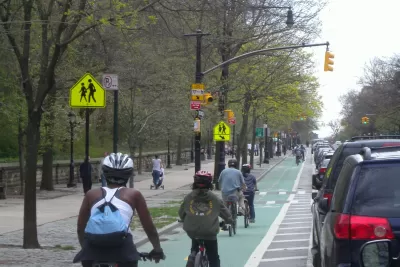
Matt Kohler takes a closer look at a new video featuring Janette Sadik-Khan, former commissioner of the New York City Department of Transportation, discussing the benefits and challenges of putting in protected bike lanes. Sadik-Khan came on board in 2007, and she describes the biking environment of New York up until that point as dangerous for cyclists.
She was behind the first protected bike lane in the United States, a route on Ninth Avenue in Manhattan, with a design that made the street much safer for bikers. It was a difficult project to implement because parking would be eliminated for the lane and people feared the outcome of that change. “However, reducing the share of road space for cars didn’t usher in the apocalypse, and the protected bicycleway turned out to be a boon for the local economy,” reports Kohler.
In addition, the number of crashes with injuries went down by almost 50 percent and traffic flowed better. Sadik-Kahn says the protected bike lane created a street that is better for all stakeholders – businesses, drivers, cyclists, and pedestrians. Developing safe and reliable networks of bike lanes is one of the best investments that cities can make, she says.
Read the full story: Video: Protected bikeways make cities safer and boost the economy
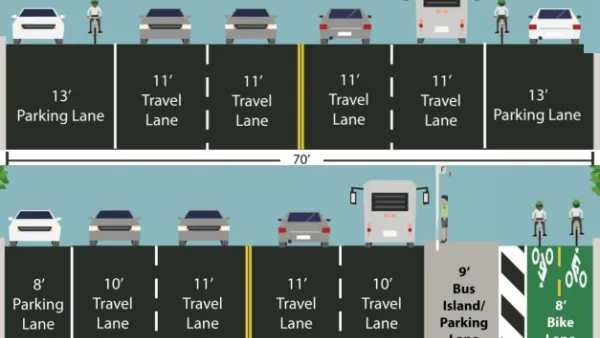
A New Protected Bike Lane in the Bronx
The new protected, two-way bike lane on Broadway adjacent to Van Cortlandt Park could induce envy.
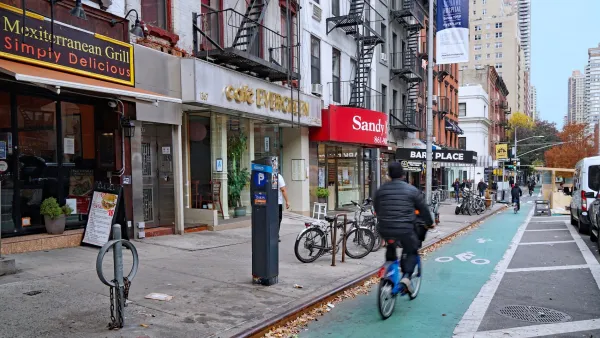
Study: Protected bike lanes increase Citi Bike rides by nearly 400 rides a month
An analysis of millions of NYC bike share rides reveals that only protected bike lanes have a 'statistically significant' increase in ridership.
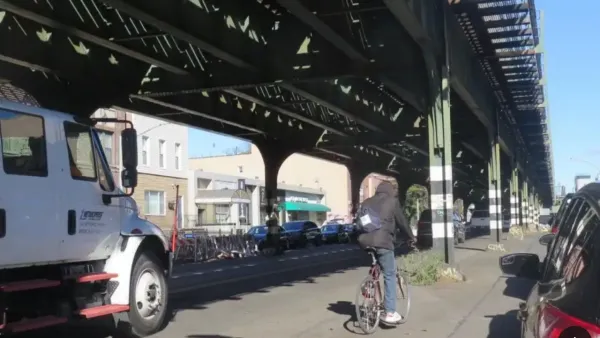
Judge Orders Removal of Queens Bike Lane on One of NYC’s Most Dangerous Corridors
A group of local businesses and a school sued the city, arguing that NYCDOT didn’t follow appropriate procedures and failed to address safety concerns before going ahead with the project.

Planetizen Federal Action Tracker
A weekly monitor of how Trump’s orders and actions are impacting planners and planning in America.

California plans to bury El Niño’s downpour
If the state plays its cards right, it may be able to store a billion acre-feet of El Niño’s water in aquifers.

Desperate measures: Advocates weigh draining Lake Powell to fill Colorado River
Draining the reservoir could reduce evaporation losses by a couple hundred thousand acre-feet.

Voters across the country reject data centers
Dozens of communities voted on measures to restrict the buildout of data centers.

US buildings threatened, destroyed by fires set to triple by 2060
Researchers found a high fire risk for socioeconomically vulnerable neighborhoods in the American West.

LA residents may be allowed to paint their own crosswalks
Councilwoman Katy Yaroslavsky put out a motion instructing the Los Angeles Department of Public Transportation to study the feasibility of allowing volunteers to paint crosswalks.

FREE Course: Walkable City 1: Why Walkability?
After describing his path towards focusing on walkability as the essence of good planning, Jeff Speck marches through his five principal reasons for making more walkable places.
Reinventing Malls: Planning Alchemy—Turning Gray Fields Into Gold
The course focuses on the opportunities and imperatives that shape reinvention of mall sites.


City of Rosemead
Rutgers University, Edward J. Bloustein School of Planning and Public Policy
One Hundred Miles
Hunter College, City University of New York (CUNY)
The Architects Foundation
University of Cincinnati Online
City of Cambridge
Montrose County
The Pocatello Development Authority