Levees can save towns, but they can also push water downstream making floods worse, meaning that if wealthier places are protected, it’s sometimes at the expense of poor communities.


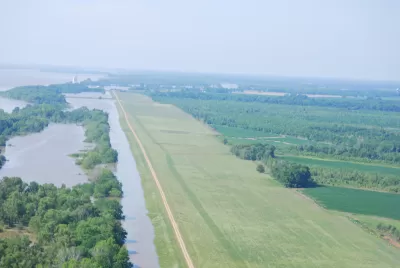
Where rivers flood, the most common technique used by the Army Corps of Engineers to protect homes is to build levees. Reporting from ProPublica suggest that this strategy creates some harm. When rivers don't overflow their banks, that water has to go somewhere, so levees that protect one area can worsen flooding in somewhere else. This makes the placement of levees a sticky issue.
The Army Corps of Engineers tries to prevent property damage so it looks at the value of land and homes near rivers and uses that information to help decide where to build levees. "But the calculations favor highly valued property over less affluent communities. And the Corps has favored levee-building over nonstructural fixes such as buying out homes to create space for the river to spread out during a flood — practices that many experts say are more effective in the long run, but which the Corps concluded were 'seldom economically justified,'" report Lisa Song, Patrick Michels, and Al Shaw for ProPublica. As climate change exacerbates extreme weather, flood infrastructure is going to become increasingly important.
Read the full story: Flood Thy Neighbor: Who Stays Dry and Who Decides?

Planetizen Federal Action Tracker
A weekly monitor of how Trump’s orders and actions are impacting planners and planning in America.

California plans to bury El Niño’s downpour
If the state plays its cards right, it may be able to store a billion acre-feet of El Niño’s water in aquifers.

Desperate measures: Advocates weigh draining Lake Powell to fill Colorado River
Draining the reservoir could reduce evaporation losses by a couple hundred thousand acre-feet.

Chicago voters approve permanent festival grounds, penalty for vacant property owners
Currently, major summer and fall festivals take over public parks for weeks at a time, drawing criticism from nearby residents

NYC votes to cut outdoor dining red tape, speed up permitting
New York City also voted to allow the Department of Transportation to begin work on urgent projects before notifying elected officials.

California appears to reject Prop. 45
The proposition would have expanded the projects that qualify for a streamlined environmental review, effectively paring down the California Environmental Quality Act.

FREE Course: Walkable City 1: Why Walkability?
After describing his path towards focusing on walkability as the essence of good planning, Jeff Speck marches through his five principal reasons for making more walkable places.
Reinventing Malls: Planning Alchemy—Turning Gray Fields Into Gold
The course focuses on the opportunities and imperatives that shape reinvention of mall sites.

City of Rosemead
Rutgers University, Edward J. Bloustein School of Planning and Public Policy
One Hundred Miles
Hunter College, City University of New York (CUNY)
The Architects Foundation
University of Cincinnati Online
City of Cambridge
Montrose County
The Pocatello Development Authority