Some of the transit agency’s audio systems haven’t been upgraded in 40 years.


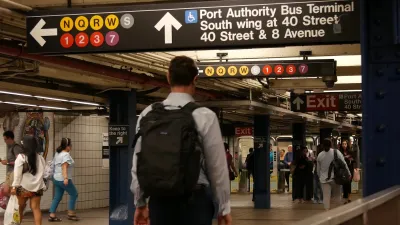
The Metropolitan Transportation Authority is replacing its “garbled” audio systems, some of which haven’t been updated in 40 years, Stephen Nessen writes for Gothamist. The agency put out a request to vendors for ways to upgrade the transit system’s communication technology, which includes everything from audio announcements to visual displays, and has put aside $800 million for the new systems.
Gothamist reports:
The MTA is seeking a new announcement system that has better “audibility, intelligibility, and relevance,” according to documents posted on its website. The request calls for a speaker and amplifier system that is "intelligent" and can adjust its volume based on the amount of noise on the platform. The agency also wants the public address system to be AI-assisted and capable of delivering messages in multiple languages.
Currently, 76 of MTA's 472 subway stations are completely disconnected from the rail control center, preventing these stations from getting real-time updates about service. The audio announcements at these stations are made by employees, who convey information they hear secondhand from workers at the rail control center. This system “leads to poor and delayed information to our customers and worse, these announcements are not at all connected to any of the station countdown clocks or visual signage infrastructure, which can result in irrelevant or even conflicting information,” reads the document on the MTA’s website.
Read the full story: MTA plans upgrade to aging, garbled subway announcement systems
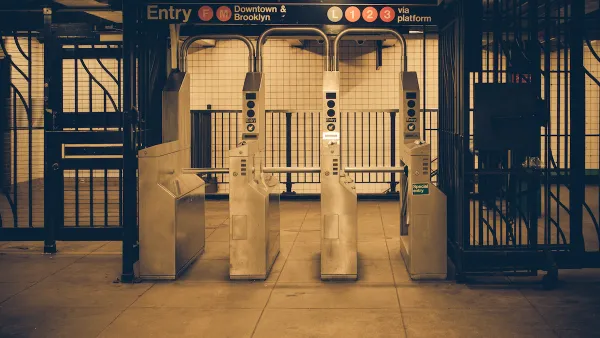
NYC Tests New Subway Gates to Limit Fare Evasion
The mayor has taken a strong interest in enforcing fare collection at the city’s transit stations.
MTA Spending Millions on Cleaning, but Disagreement Over the Need
Deep cleaning of the New York City subway and bus system is part of the Metropolitan Transportation Authority’s coronavirus response. But it is costly and time consuming, and the public health benefits are not entirely clear.
New York MTA Seeks Federal Funding Relief as Ridership Plummets
The Metropolitan Transportation Authority has seen significant ridership drops due to the coronavirus. The agency is asking Congress for $4 billion to help it through the crisis.

Planetizen Federal Action Tracker
A weekly monitor of how Trump’s orders and actions are impacting planners and planning in America.

Eastern Nebraska is running out of electricity
Data centers and electrification are straining eastern Nebraska’s grid, throttling economic development.

Study reveals best places in the U.S. for cycling, walking
New research from Streetlight Data examines bicycle and pedestrian miles per capita in the 100 largest U.S. cities by population.

Next-generation nuclear reactors are coming to Texas
The reactors will not require towering containment structures thanks to new safety features.

California distributes $1.3 billion to prevent transit service cuts, bolster projects
Twenty-eight projects across California received a portion of the funding.

Pennsylvania Democrats have 15 affordability, clean energy bills for flipped state Senate
Bills in consideration include a bill supporting geothermal energy and a bill supporting solar on warehouses.

FREE Course: Walkable City 1: Why Walkability?
After describing his path towards focusing on walkability as the essence of good planning, Jeff Speck marches through his five principal reasons for making more walkable places.
Reinventing Malls: Planning Alchemy—Turning Gray Fields Into Gold
The course focuses on the opportunities and imperatives that shape reinvention of mall sites.

City of Charlotte
City of Rosemead
Rutgers University, Edward J. Bloustein School of Planning and Public Policy
University of Michigan School for Environment and Sustainability (SEAS)
Hunter College, City University of New York (CUNY)
The Architects Foundation
City of Cambridge
The Pocatello Development Authority
The Urban Renewal Agency of the City of Pocatello