The downtown streetcar saw a surge in ridership after it eliminated fares in January.


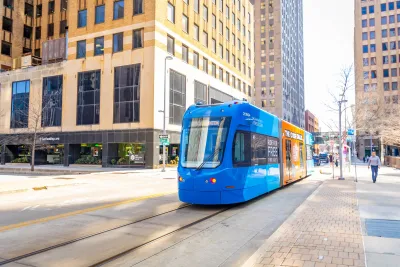
The Central Oklahoma Transportation and Parking Authority announced plans to keep the Downtown OKC streetcar fare-free after a pilot program that began in January led to a rise in ridership of up to 74%, reports Brett Fieldcamp in Oklahoma City Free Press.
"As our city continues to invest in projects and host major events coming to downtown Oklahoma City, the streetcar can improve downtown circulation, help ease traffic congestion and boost economic activity for downtown businesses," said Jesse Rush, Director of EMBARK, the city's transit authority.
In his State of the City address, Mayor David Holt signaled strong support for the project and other initiatives to boost transit, and acknowledged that fare revenue is often a small part of a transit system's operating budget. "According to Holt’s post Friday, the measure of success for a public service shouldn’t be a dollar amount or a financial return on investment, but the enthusiasm with which the public engages with the service." Holt added, "if the community is using it, it has value."
Read the full story: OKC Streetcar to remain permanently free after pilot program success

Oklahoma City Streetcar Goes Fare-Free in January
The system saw its highest ridership ever in the last fiscal year.
Fisticuffs: The argument FOR fare-free transit
When the barrier to entry drops to zero, magic can happen.

Fisticuffs: The argument AGAINST fare-free transit
If a terrible bus becomes free, will it truly free you?

Desperate measures: Advocates weigh draining Lake Powell to fill Colorado River
Draining the reservoir could reduce evaporation losses by a couple hundred thousand acre-feet.

Eastern Nebraska is running out of electricity
Data centers and electrification are straining eastern Nebraska’s grid, throttling economic development.

Malls are becoming the midtowns of the future
Mall and office park redevelopments are a generational opportunity to create new nodes of urbanity.

NYC breaks ground on anti-flooding infrastructure project
New York City's new system will reduce stormwater flows to local sewers by 90%.

One Kentucky town’s secret to affordable housing
The Smoketown Community Land Trust has already built seven affordable homes for community members.

Houston gains petal-shaped cooling infrastructure to make streets more ‘delightful’
The city has installed the pavilions along 15 blocks in Houston.

FREE Course: Walkable City 1: Why Walkability?
After describing his path towards focusing on walkability as the essence of good planning, Jeff Speck marches through his five principal reasons for making more walkable places.
Reinventing Malls: Planning Alchemy—Turning Gray Fields Into Gold
The course focuses on the opportunities and imperatives that shape reinvention of mall sites.

City of Rosemead
Rutgers University, Edward J. Bloustein School of Planning and Public Policy
One Hundred Miles
University of Michigan School for Environment and Sustainability (SEAS)
Hunter College, City University of New York (CUNY)
The Architects Foundation
City of Cambridge
Montrose County
The Pocatello Development Authority