City officials want to explore capping or even removing a portion of the freeway in the Pico neighborhood.


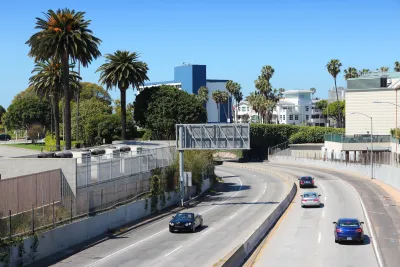
The Santa Monica City Council approved the receipt of a $2 million federal grant to study capping or removing a section of Interstate 10, reports Maaz Alin in the Santa Monica Daily Press.
"The grant, from the U.S. Department of Transportation's Reconnecting Communities Pilot Program, will fund a feasibility study of potential "cap parks" along the I-10 between 11th and 20th streets in the city's Pico Neighborhood." The grant requires that the city offer $505,712 in matching funds.
The cap park plan could help stitch together a neighborhood that was divided by the freeway, which displaced roughly 1,500 residents when it was first built. "Councilmember Ellis Raskin, who made the motion to accept the grant, called the freeway the most significant environmental hazard in Santa Monica and said capping it would not be enough." The study will analyze other potential options, including removing a portion of the freeway altogether.
Read the full story: Santa Monica accepts $2M grant to study capping the I-10


Santa Monica Offers Affordable Housing to Residents Displaced by Freeway Construction
A new program seeks to make restitution for the damage inflicted on Black communities by highway construction and urban renewal.

Reimagining the Urban Freeway
With the new administration placing racial justice and equity at the forefront of transportation policy, will America finally reckon with the legacy of its freeways?

Philadelphia lawmakers fight to save 'Chinatown Stitch' from Trump cuts
The freeway cap project, approved and funded under the Biden administration, is now in jeopardy after the federal government rescinded all but $8 million in funding.

Planetizen Federal Action Tracker
A weekly monitor of how Trump’s orders and actions are impacting planners and planning in America.

‘Going backwards:’ Baltimore mayor, students rally against state's transit funding plan
Maryland's proposed six-year plan provides no funding for Baltimore’s BMORE bus program and reduces its road maintenance funding.

Detroit to transform waterfront with $2.2 billion investment
Developers will convert about 18 acres of unused parking lot space into civic spaces.

U.S.-Iran war may have ‘devastating’ impact on cost to warm homes
Vermont and Maine residents may see a 76% increase in the cost of warming their homes this winter.

Senate bill would ‘overhaul’ environmental permitting laws
Under the proposed act, government agencies would also not be able to suspend or rescind permits after granting them.

Exemption applications for NYC’s pied-à-terre tax see 55% success rate
The city sent nearly 40% of its initial pied-à-terre tax warnings erroneously.

FREE Course: Walkable City 1: Why Walkability?
After describing his path towards focusing on walkability as the essence of good planning, Jeff Speck marches through his five principal reasons for making more walkable places.
Reinventing Malls: Planning Alchemy—Turning Gray Fields Into Gold
The course focuses on the opportunities and imperatives that shape reinvention of mall sites.

One Hundred Miles
County of Mendocino
planning NEXT
The Architects Foundation
University of Cincinnati Online
Montrose County
Northern Illinois Transit Authority (NITA)
The Pocatello Development Authority