Carmel, Indiana has built over 150 roundabouts as part of a broader mobility and development strategy.


The city of Carmel, Indiana has 158 roundabouts, making it the roundabout capital of the United States.
According to a CNU Public Square article by Robert Steuteville, the city has eliminated almost all of its traffic lights in favor of roundabouts that keep traffic flowing smoothly and more safely.
But traffic safety isn't the only benefit of the roundabouts. Steuteville, who has written about them before, adds that they play a key role in Carmel's downtown development. In fact, "This intersection type complements Carmel’s broader redevelopment efforts, which promote compact, mixed-use development and active transportation."
According to Henry Mestetsky, executive director of Carmel Redevelopment Commission, "By replacing congestion with continuity, [the roundabouts] created safer streets, cleaner air, and a public realm that invites walking, biking, and investment," becoming "catalysts for redevelopment, supporting compact, mixed-use districts and demonstrating how thoughtful transportation design can transform a city from the ground up."
After the town installed roundabouts in its town center, it was able to break up former 'superblocks' into smaller blocks with walkable frontage suitable for mixed-use development. Roundabouts also provide new green spaces and platforms for civic art.
City Engineer Bradley Pease explains that the roundabouts are part of a broader mobility vision: "Carmel’s investment extends to multi-use paths, thoughtfully narrowed roadways, and the intentional activation of public spaces that encourage walking, biking, gathering, and everyday community life."
FULL STORY: How roundabouts helped to build a downtown

Study: Roundabouts are Primarily in Wealthier Neighborhoods
A North Carolina study sheds light on inequities in road safety interventions.
How I Learned to Stop Worrying and Love the Roundabout
What drives the U.S. backlash to roundabouts — objectively safer and more efficient than stop-and-go intersections?
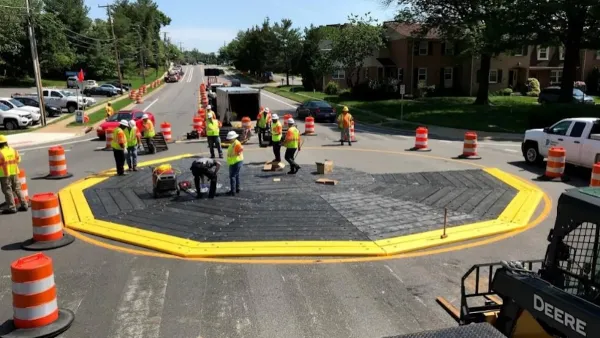
‘Modular Roundabouts’ Offer Quick-Build Traffic Safety Solution
The prefabricated roundabouts can be installed more quickly and at a much lower cost than traditional concrete traffic circles.

Planetizen Federal Action Tracker
A weekly monitor of how Trump’s orders and actions are impacting planners and planning in America.

The state-sanctioned urbicide of Austin
People don’t kill cities. Freeways do.

US to reduce Colorado River water deliveries to Mexico
A new Colorado Treaty amendment reduces Mexico’s Colorado River water allocation by 250,000 acre feet.

Airbnb launches $250 million 'last-dollar financing' housing accelerator, makes first investment in Austin
The company will put $6.4 million towards affordable housing development in Texas’ capital.

Guerilla urbanists are building DIY bus stop benches in Chicago
A before-and-after of one of the bus stops with a new bench. The new benches are not officially sanctioned or permitted, but the residents who placed them hope they will be the start of a network of DIY benches across the city.

Mamdani overhauls NYC's Vision Zero plan with 100 new policy goals
The overhaul aims to reduce traffic deaths and make streets safer for pedestrians, cyclists and drivers through lower speed limits, new safety infrastructure and more.

FREE Course: Walkable City 1: Why Walkability?
After describing his path towards focusing on walkability as the essence of good planning, Jeff Speck marches through his five principal reasons for making more walkable places.
Reinventing Malls: Planning Alchemy—Turning Gray Fields Into Gold
The course focuses on the opportunities and imperatives that shape reinvention of mall sites.

Eagle County Government
Harvard University Graduate School of Design
Nashville Planning Department
The Architects Foundation
University of Cincinnati Online
The Pocatello Development Authority
The Urban Renewal Agency of the City of Pocatello
Journal of the American Planning Association