Researchers say nearly half of the county’s paved surfaces could be redesigned to cool neighborhoods, manage stormwater, and improve public health.


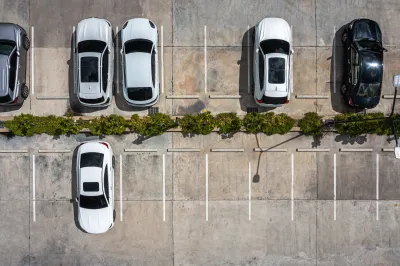
A new report called DepaveLA finds that roughly 44 percent of Los Angeles County’s 312,000 acres of pavement may not be essential for roads, sidewalks, or parking. Conducted by Accelerate Resilience L.A. and Hyphae Design Laboratory, the parcel-level analysis distinguishes between “core” pavement (such as streets) and “non-core” pavement that could potentially be redesigned or removed.
By pairing pavement data with heat, flooding, and tree canopy information, the study creates a new framework for identifying where depaving could most benefit climate resilience and public health. Researchers were surprised to find that nearly 70 percent of non-core pavement sits on private property, especially in commercial and industrial parking lots.
Rather than calling for sweeping removal, the report emphasizes practical, incremental changes. Parking lots represent one of the biggest opportunities: redesigning standard 90-degree parking into angled layouts could free up to 1,600 acres without reducing the number of spaces, creating room for trees and stormwater capture. Residential properties also hold potential; cutting small tree wells into paved patios could collectively remove over 1,500 acres of hardscape while minimally affecting usable space. Schools are another focus, as many campuses are heavily paved and expose students to extreme heat. Projects like the greening of Esperanza Elementary School demonstrate how replacing asphalt with native plants, shade trees, and stormwater features can transform “seas of asphalt” into cooler, more inviting spaces.
Still, the report’s authors stress that depaving must be thoughtful and context-sensitive. Some paved areas cap contaminated soils, particularly in industrial neighborhoods, and cannot simply be removed. Experts also note that without policy or financial incentives, private property owners have little reason to reduce hardscape. Drawing comparisons to Southern California’s lawn-replacement rebate programs, advocates suggest education and incentives could shift norms around pavement just as they did around turf. Ultimately, the goal is not to mandate wholesale removal but to spark a broader conversation: if pavement is treated as a design choice rather than a default, Los Angeles may be able to cool its hottest blocks, expand green space, and build healthier neighborhoods for the future.
Read the full story: Nearly half of L.A County’s pavement may be unnecessary, new map finds

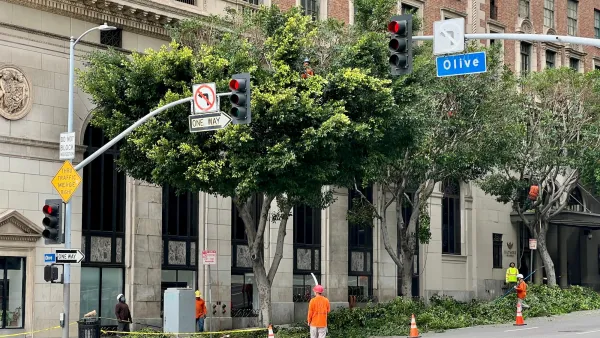
LA’s Tree Canopy is Nearing a ‘Point of Failure’
Calls to 311 for “tree emergencies” are rising, endangering a resource that helps bring down urban temperatures and reduce air pollution.

LA County Adopts First Heat Action Plan
LA County has adopted its first Heat Action Plan, a long-term, people-centered framework to reduce heat risks, protect public health, and adapt communities, homes, and public spaces to a hotter and more dangerous climate.
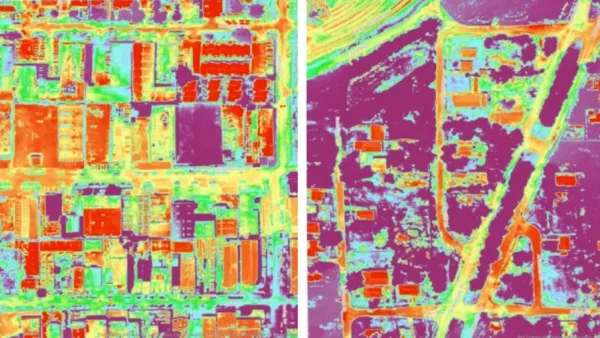
Study: Houston’s Vacant Lots Worsen Heat Island Effect
Paved lots and abandoned buildings can raise surrounding surface temperatures as much as 20 degrees, according to a new study.

Planetizen Federal Action Tracker
A weekly monitor of how Trump’s orders and actions are impacting planners and planning in America.

California plans to bury El Niño’s downpour
If the state plays its cards right, it may be able to store a billion acre-feet of El Niño’s water in aquifers.

Desperate measures: Advocates weigh draining Lake Powell to fill Colorado River
Draining the reservoir could reduce evaporation losses by a couple hundred thousand acre-feet.

Chicago Avenue bridge construction delays enrages city leaders
The bridge has been closed since 2025. The city originally aimed to re-open it in December, and now expects to finish construction in 2027.

NYC bus network redesign speeds up Queens buses
Rush routes have seen a 4.6% speed increase after the redesign.

California High-Speed Rail Authority picks trainset manufacturer
The California High-Speed Rail Authority aims to start servicing passengers by 2033.

FREE Course: Walkable City 1: Why Walkability?
After describing his path towards focusing on walkability as the essence of good planning, Jeff Speck marches through his five principal reasons for making more walkable places.
Reinventing Malls: Planning Alchemy—Turning Gray Fields Into Gold
The course focuses on the opportunities and imperatives that shape reinvention of mall sites.

City of Rosemead
Rutgers University, Edward J. Bloustein School of Planning and Public Policy
One Hundred Miles
Hunter College, City University of New York (CUNY)
The Architects Foundation
University of Cincinnati Online
City of Cambridge
Montrose County
The Pocatello Development Authority