LA County has adopted its first Heat Action Plan, a long-term, people-centered framework to reduce heat risks, protect public health, and adapt communities, homes, and public spaces to a hotter and more dangerous climate.



Los Angeles County is confronting a rapidly warming climate with the adoption of its first-ever Heat Action Plan, approved unanimously by the Board of Supervisors on February 3, 2026. The plan responds to longer, hotter, and more dangerous heat waves driven by climate change and sets out a long-term, countywide framework focused specifically on extreme heat rather than climate change broadly. Its three central goals are to create cooler outdoor spaces, ensure safer and cooler indoor environments, and improve public education about heat-related health risks.
Unlike more general climate action plans, the county’s Heat Action Plan zeroes in on heat as a distinct and growing hazard—one that is often overlooked because it causes little visible damage. As reported by Erin Stone, heat already contributes to more than 200 deaths each year in Los Angeles County and thousands of emergency room visits, with inland and valley communities experiencing the greatest impacts. Since the 1980s, summer temperatures have risen by an average of three degrees, and projections show increases of up to eight degrees in some areas by mid-century if global emissions are not dramatically reduced.
The plan also highlights how heat affects daily life in less obvious but deeply consequential ways. Nights are warming faster than days, disrupting sleep and worsening health outcomes; more than 40% of county residents surveyed reported difficulty sleeping during very hot nights. County officials emphasize that heat is an “invisible threat”—experienced everywhere, but not equally—and one that lacks formal disaster designation at the state or federal level, limiting access to funding. By coordinating efforts across departments, the county hopes the plan will strengthen public health protections and unlock additional resources.
Building on years of prior analysis, the Heat Action Plan outlines various strategies, including adding shade structures at all county bus stops, expanding tree canopy in unincorporated areas, replacing heat-absorbing pavement at schools and public spaces, enforcing indoor temperature standards for rental housing, reducing energy burdens for low-income households, and expanding cooling centers. Researchers involved in the plan note that its people-centered approach—and its innovative use of shade data alongside temperature data—positions Los Angeles County as a leader in planning for life in a hotter future.
FULL STORY: Southern California is getting hotter. LA County now has a heat action plan


LA County Adopts Maximum Indoor Temperature Ordinance to Protect Renters from Extreme Heat
LA County has adopted an ordinance capping indoor temperatures in rental units at 82 degrees Fahrenheit in unincorporated areas, aiming to protect renters from extreme heat while providing phased compliance and support for small landlords.

Federal and State Responses to Extreme Heat
Governments are mobilizing resources to address the impacts of longer and more intense heat waves on public health and infrastructure.
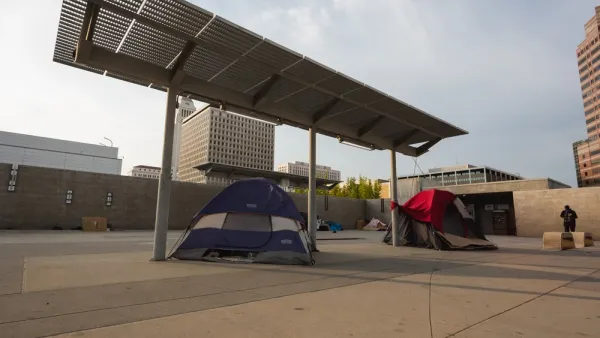
Extreme Heat Responsible for Growing Death Rates Among Unhoused People
Extreme heat events like the ‘heat dome’ that baked Southern California last summer kill a disproportionate number of people experiencing homelessness, who have fewer resources to protect themselves from the scorching sun.

The state-sanctioned urbicide of Austin
People don’t kill cities. Freeways do.

US to reduce Colorado River water deliveries to Mexico
A new Colorado Treaty amendment reduces Mexico’s Colorado River water allocation by 250,000 acre feet.

New Jersey’s second-largest city bans standalone data centers
Jersey City will continue to allow co-location facilities, such as those meant for research institutions that store their own data.

Amtrak not solely to blame for New Jersey commuter rail's unreliability, report finds
A new study from the Garden State Initiative found that NJ Transit’s budget grew 20% across a 4 year period, but reliability declined significantly over the same period.

EPA erases limits on planet-warming pollution from power plants
Under Monday’s plan, power plants would still have some limits on how much mercury, arsenic and other contaminants they can emit.

Phoenix announces new on-demand transit service, more frequent RAPID buses
Both new services will launch in October, and are part of Phoenix's Project Effective Access Solutions for Easing Congestion.

FREE Course: Walkable City 1: Why Walkability?
After describing his path towards focusing on walkability as the essence of good planning, Jeff Speck marches through his five principal reasons for making more walkable places.
Reinventing Malls: Planning Alchemy—Turning Gray Fields Into Gold
The course focuses on the opportunities and imperatives that shape reinvention of mall sites.

Eagle County Government
Harvard University Graduate School of Design
Nashville Planning Department
The Architects Foundation
University of Cincinnati Online
The Pocatello Development Authority
The Urban Renewal Agency of the City of Pocatello
Journal of the American Planning Association