The program that allows EV drivers to use carpool lanes alone has issued 1,211,530 stickers since it began in 2000.


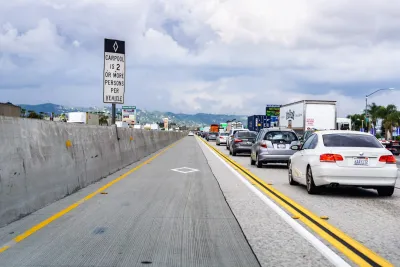
California’s popular carpool lane incentive for electric cars went away on Monday, and drivers caught violating the new rules after a 60-day grace period will face a minimum $490 fine.
As Paul Rogers explains in The Mercury News, “For the past 25 years, federal law has allowed states to decide whether they want to grant carpool-lane access to electric vehicles.” But those permissions expired on September 30, and Congress has not reauthorized the program, forcing California to end its incentive. The state passed a law extending the program, but it can’t take effect without congressional reauthorization.
The change will be a big adjustment for EV drivers who have become used to shaving significant amounts of time off their commutes, some of whom were motivated by the privilege to buy an electric car. “When the program first began, after former Gov. Gray Davis signed AB 71, a law written by former Republican Assemblyman Jim Cunneen of San Jose in 1999, less than 2% of cars on the road were electric. Last year in California, 25.3% of the new vehicles sold were electric, according to the California Energy Commission.”
FULL STORY: California’s popular EV carpool lane decal program ends Monday: $490 tickets for violators

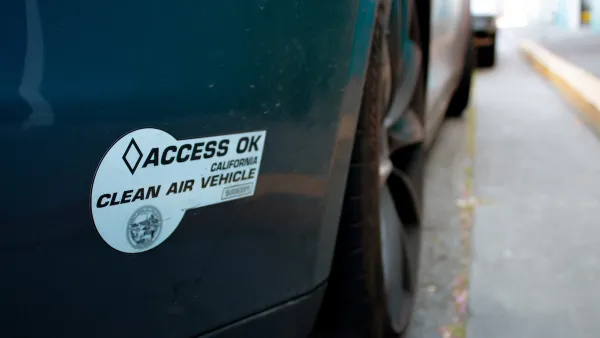
EVs Now Barred From Freeway HOV Lanes
Congress failed to renew a federal program allowing states to let electric car drivers use carpool lanes without additional passengers, forcing California to end EV access to its HOV lanes.
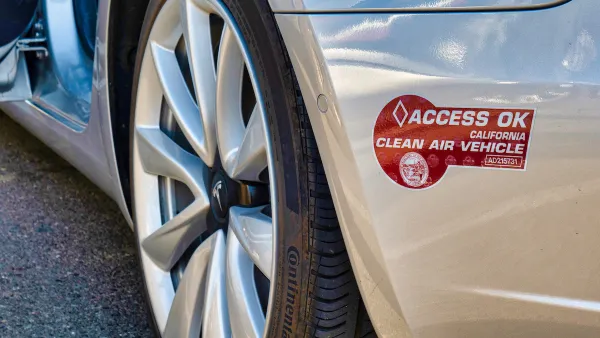
California EV Owners To Lose Carpool Lane Privilege
A program that began in 1999 to encourage more electric car ownership is set to expire next year without Congressional and state action.
Swapping your gas car for an EV is greener than keeping it, research shows
An EV repays the 'carbon debt' caused by building it after 4,400 miles.

Planetizen Federal Action Tracker
A weekly monitor of how Trump’s orders and actions are impacting planners and planning in America.

The state-sanctioned urbicide of Austin
People don’t kill cities. Freeways do.

US to reduce Colorado River water deliveries to Mexico
A new Colorado Treaty amendment reduces Mexico’s Colorado River water allocation by 250,000 acre feet.

Baltimore to break ground on $50 million Transit Priority Project
The project will bring faster bus trips, safer streets and better bike connections to Baltimore.

Airbnb launches $250 million 'last-dollar financing' housing accelerator, makes first investment in Austin
The company will put $6.4 million towards affordable housing development in Texas’ capital.

Guerilla urbanists are building DIY bus stop benches in Chicago
A before-and-after of one of the bus stops with a new bench. The new benches are not officially sanctioned or permitted, but the residents who placed them hope they will be the start of a network of DIY benches across the city.

FREE Course: Walkable City 1: Why Walkability?
After describing his path towards focusing on walkability as the essence of good planning, Jeff Speck marches through his five principal reasons for making more walkable places.
Reinventing Malls: Planning Alchemy—Turning Gray Fields Into Gold
The course focuses on the opportunities and imperatives that shape reinvention of mall sites.

Eagle County Government
Harvard University Graduate School of Design
Nashville Planning Department
The Architects Foundation
University of Cincinnati Online
The Pocatello Development Authority
The Urban Renewal Agency of the City of Pocatello
Journal of the American Planning Association