An EV repays the 'carbon debt' caused by building it after 4,400 miles.



A new study published in the journal Science indicates that even considering the environmental impacts of building new electric vehicles, swapping out a gas-powered car for an EV is the more eco-friendly choice.
As Tik Root explains in a piece in Grist, "swapping even a two-year-old gas car for an EV leads to a lifetime emissions savings of roughly 50 percent," according to the study. Despite a common belief otherwise, "The emissions saved by driving an EV very quickly compensate for the planet-warming gases generated by building it."
Professor and study author Elliot Campbell says the study was designed largely in favor of gas cars, for example, treating the emissions caused by building gas cars as a sunk cost. "EV still came out ahead, which suggests that climate-conscious drivers should make the switch as soon as it’s feasible."
The study notes that the benefit is greatest in places where the grid generates the most renewable energy. "But even in the Rockies, where coal and natural gas are the norm, an EV is better than anything getting less than 68 mpg."
Read the full story: Your gas car works fine. Consider an EV anyway, scientists say.
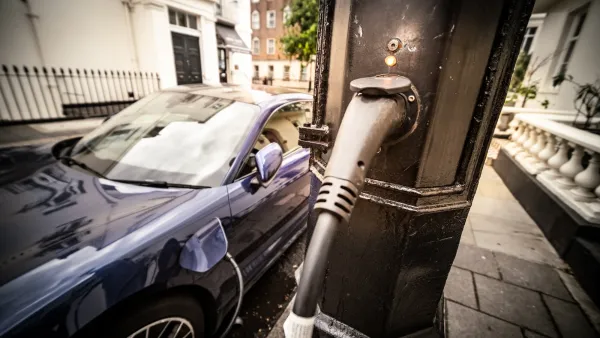
DC light poles will soon charge your electric car
The city awarded three grants to companies that will install more publicly available EV chargers.

Charging Ahead: Why EV Infrastructure Is Still Expanding Despite Market Uncertainty
Electrify America is forging ahead with major charging network expansions, confident that long-term demand will keep rising despite short-term EV market and policy disruptions.
10 States Follow Through on Promise to Put 3.3 Million EVs on the Road
Rebate programs are at the heart of collaborative success.

Planetizen Federal Action Tracker
A weekly monitor of how Trump’s orders and actions are impacting planners and planning in America.

Eastern Nebraska is running out of electricity
Data centers and electrification are straining eastern Nebraska’s grid, throttling economic development.

Move over, LA: St. Louis gears up for Olympics, invests millions in downtown redevelopment
The Missouri city will host the 2028 Olympic soccer group stage and knockout matches.

Dallas releases zoning code overhaul to officials
The drafted overhaul is over 400 pages long.

NYC renovations for dangerous, ‘mercilessly crammed’ street delayed until 2027
Construction was supposed to begin this fall.

San Diego’s Midway Rising project gets greenlight from city council
The project looks to become the largest affordable housing development in California's history.

FREE Course: Walkable City 1: Why Walkability?
After describing his path towards focusing on walkability as the essence of good planning, Jeff Speck marches through his five principal reasons for making more walkable places.
Reinventing Malls: Planning Alchemy—Turning Gray Fields Into Gold
The course focuses on the opportunities and imperatives that shape reinvention of mall sites.

City of Rosemead
Rutgers University, Edward J. Bloustein School of Planning and Public Policy
One Hundred Miles
University of Michigan School for Environment and Sustainability (SEAS)
Hunter College, City University of New York (CUNY)
The Architects Foundation
City of Cambridge
The Pocatello Development Authority
The Urban Renewal Agency of the City of Pocatello