Curb management is quickly becoming a key part of urban planning as delivery vans, ride share vehicles, shared mobility devices, transit, and private cars compete for scarce curb space.


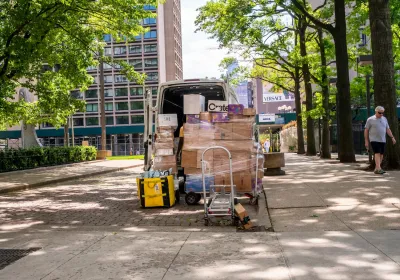
City curbs, originally built to support drainage and delineate the edge of streets versus sidewalks, are becoming a hotly contested piece of urban real estate as delivery vehicles, shared bikes and scooters, ride hailing cars, transit buses, and other vehicles vie for space to move, stop, and park.
In a piece for the Congress for New Urbanism’s Public Square, Andrés Franco traces the changes that curbs and curbside space have gone through. “Today, the curb plays a critical role in supporting business, public transit, bike infrastructure, last-mile deliveries, waste collection, outdoor dining, and more.”
In recent years, a boom in e-commerce and home deliveries for everything from meals to toothpaste has changed the calculation for cities. “These challenges are not just design problems, they require coordinated, comprehensive strategies that align urban design with policy tools like updated regulations, pricing mechanisms, and enforcement.”
Franco outlines several strategies cities are undertaking to better manage their curb space. New York City is setting up on-street microhubs where delivery vehicles can offload packages to smaller cargo bikes or vans. “In addition to microhubs, some cities are experimenting with dynamic curb pricing and time-based restrictions to better manage demand and discourage double parking during peak hours.”
For Franco, “ The curb is no longer a passive, overlooked boundary, on the contrary, it’s an active, multifunctional space of the street that requires intentional design.” It requires flexible, adaptable infrastructure that recognizes the many uses for curb and street space beyond moving and storing cars.
FULL STORY: From edge to epicenter

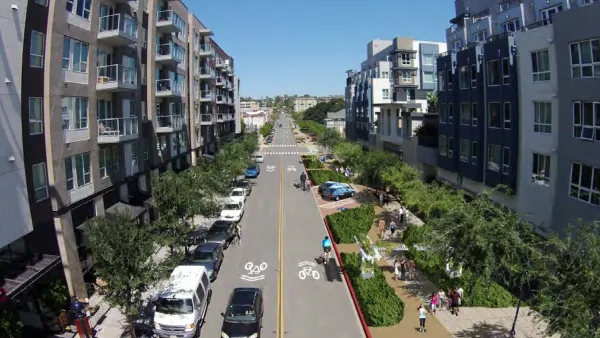
San Diego Swaps Parking Lane for Kid-Friendly Mini Park
The block-long greenway will feature interactive play equipment and landscaping.
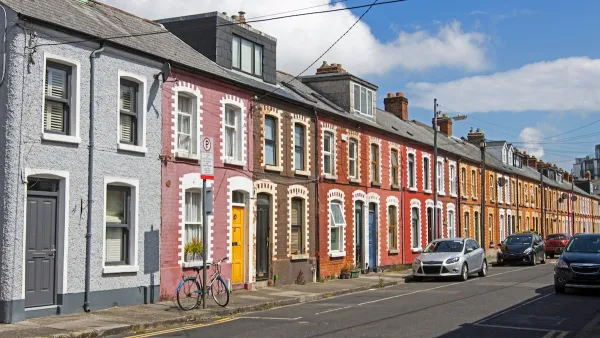
Reimagining the Curb: How Smart Curb Management is Transforming Urban Mobility
Modern demands for curbside space call for new ways to manage and allocate it.
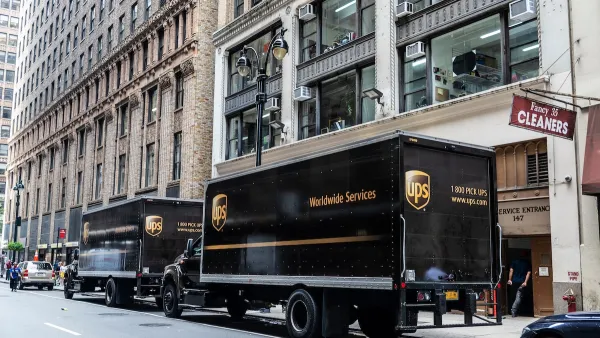
State of Curbs & Parking Report Reveals Glut of Data
As the uses of curb space become more diverse, city officials are working to understand how to best manage this increasingly important urban amenity.

Planetizen Federal Action Tracker
A weekly monitor of how Trump’s orders and actions are impacting planners and planning in America.

The state-sanctioned urbicide of Austin
People don’t kill cities. Freeways do.

US to reduce Colorado River water deliveries to Mexico
A new Colorado Treaty amendment reduces Mexico’s Colorado River water allocation by 250,000 acre feet.

5 New England states march closer to 800 megawatt wind energy project
Securing federal approval for the project may be complicated under the Trump administration, which has historically been hostile towards domestic wind power.

Baltimore to break ground on $50 million Transit Priority Project
The project will bring faster bus trips, safer streets and better bike connections to Baltimore.

Airbnb launches $250 million 'last-dollar financing' housing accelerator, makes first investment in Austin
The company will put $6.4 million towards affordable housing development in Texas’ capital.

FREE Course: Walkable City 1: Why Walkability?
After describing his path towards focusing on walkability as the essence of good planning, Jeff Speck marches through his five principal reasons for making more walkable places.
Reinventing Malls: Planning Alchemy—Turning Gray Fields Into Gold
The course focuses on the opportunities and imperatives that shape reinvention of mall sites.

Eagle County Government
Harvard University Graduate School of Design
Nashville Planning Department
The Architects Foundation
University of Cincinnati Online
The Pocatello Development Authority
The Urban Renewal Agency of the City of Pocatello
Journal of the American Planning Association