A new law calls for a minimum ridership of 6,000 passengers in the first year for new bus rapid transit lines. To date, no bus lines in the Tampa Bay region come close.


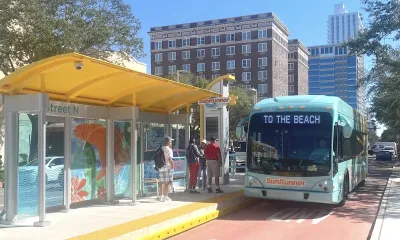
Tampa Bay’s SunRunner, the first rapid transit system in the region, could lose some of its dedicated lanes, reports Shauna Muckle in Tampa Bay Times.
Some state lawmakers claim the buses don’t have enough ridership to warrant dedicated lanes. Now, the Florida Department of Transportation is requiring new dedicated bus lanes to maintain 6,000 riders per day during their opening year. FDOT is also conducting “what it calls a routine review of lane repurposing projects around the state, including the SunRunner.”
Muckle points out that “No buses in Tampa Bay currently serve that many riders. One fare-free route in Tampa has about 5,000 riders each weekday, while other popular routes average about half that.”
According to Darden Rice, chief planning and community affairs officer for the Pinellas Suncoast Transit Authority, it takes years for a new line to reach peak ridership estimates as the public learns to use a new line and density along the line increases. St. Petersburg, Rice points out, has been slow to change zoning codes to encourage denser development along the SunRunner.
Even so, traffic is moving faster for both buses and cars along the SunRunner route, and crashes are down 40 percent since the service launched.
FULL STORY: Could the SunRunner lose part of its dedicated lane?


Experts Reject Florida Study That Killed St. Pete Bus Lane as ‘Incomplete,’ ‘Unfair’
A transit activist has filed a suit against FDOT, which used a a one-page study to justify removing a dedicated bus lane.
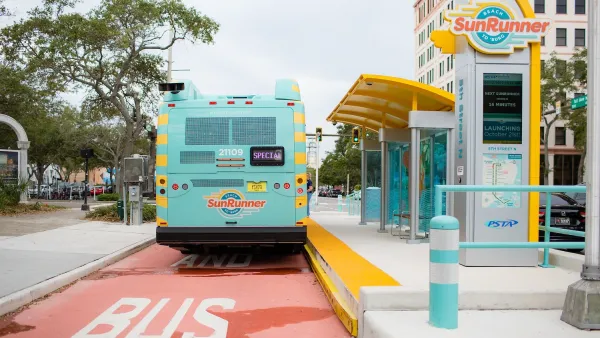
Lawsuit Claims Florida Bus Lane Removal was Illegal
The state cites an increase in crashes and congestion as reasons for eliminating a dedicated bus lane on the SunRunner BRT line, but city data tells a different story.
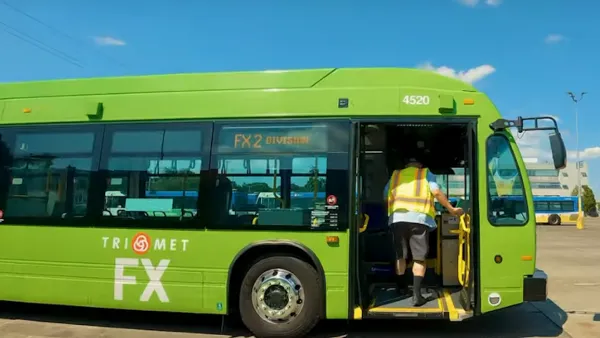
Portland ‘BRT Light’ Line Shows Promise
Despite not having fully dedicated bus lanes, Portland’s new ‘light’ bus rapid transit line is significantly reducing travel times.

Planetizen Federal Action Tracker
A weekly monitor of how Trump’s orders and actions are impacting planners and planning in America.

The state-sanctioned urbicide of Austin
People don’t kill cities. Freeways do.

US to reduce Colorado River water deliveries to Mexico
A new Colorado Treaty amendment reduces Mexico’s Colorado River water allocation by 250,000 acre feet.

Baltimore to break ground on $50 million Transit Priority Project
The project will bring faster bus trips, safer streets and better bike connections to Baltimore.

Airbnb launches $250 million 'last-dollar financing' housing accelerator, makes first investment in Austin
The company will put $6.4 million towards affordable housing development in Texas’ capital.

Guerilla urbanists are building DIY bus stop benches in Chicago
A before-and-after of one of the bus stops with a new bench. The new benches are not officially sanctioned or permitted, but the residents who placed them hope they will be the start of a network of DIY benches across the city.

FREE Course: Walkable City 1: Why Walkability?
After describing his path towards focusing on walkability as the essence of good planning, Jeff Speck marches through his five principal reasons for making more walkable places.
Reinventing Malls: Planning Alchemy—Turning Gray Fields Into Gold
The course focuses on the opportunities and imperatives that shape reinvention of mall sites.

Eagle County Government
Harvard University Graduate School of Design
Nashville Planning Department
The Architects Foundation
University of Cincinnati Online
The Pocatello Development Authority
The Urban Renewal Agency of the City of Pocatello
Journal of the American Planning Association