More than 20 states have laws banning or limiting happy hours at bars and restaurants. Now, some are revisiting these regulations in an effort to boost commerce in struggling downtown districts.


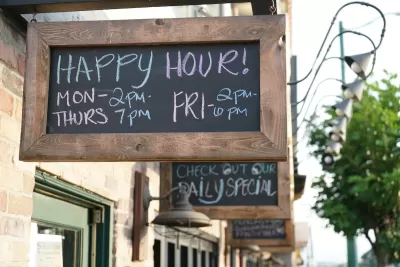
Some states are reevaluating their restrictions on downtown happy hours at bars and restaurants in an attempt to bring more people — and money — back to floundering downtown economies.
According to a Route Fifty article by Kaitlyn Levinson, happy hours were banned or restricted in some states after a rash of high-profile drunk driving deaths in the 1980s. However, research has not borne out a connection between discounted alcohol hours and higher car crash rates.
Now, some states are looking to expand happy hours or reduce restrictions to encourage more business at downtown establishments. In Massachusetts, a proposal to overturn a 1984 law banning happy hours awaits passage from the state’s House of Representatives.
Some cities are also establishing outdoor drinking zones where people can walk around with alcoholic beverages. “The ‘sip and stroll’ model could even have a bigger economic impact than expanded happy hour laws,” Levinson writes.
FULL STORY: Can happy hour attract people downtown again?

Major US Cities Still Suffering Downtown Decline
Research shows that the “donut effect” hollowing out central business districts since the pandemic continues to cause economic decline in the 12 largest American cities.
The nation's 10 'stickiest' downtowns
How often do residents visit your downtown?

Small 'maker' businesses are good for downtowns — and data proves it
Small-scale manufacturers tend to be more engaged in the local supply chain, contributing to economic revitalization.

The state-sanctioned urbicide of Austin
People don’t kill cities. Freeways do.

US to reduce Colorado River water deliveries to Mexico
A new Colorado Treaty amendment reduces Mexico’s Colorado River water allocation by 250,000 acre feet.

New Jersey’s second-largest city bans standalone data centers
Jersey City will continue to allow co-location facilities, such as those meant for research institutions that store their own data.

Amtrak not solely to blame for New Jersey commuter rail's unreliability, report finds
A new study from the Garden State Initiative found that NJ Transit’s budget grew 20% across a 4 year period, but reliability declined significantly over the same period.

EPA erases limits on planet-warming pollution from power plants
Under Monday’s plan, power plants would still have some limits on how much mercury, arsenic and other contaminants they can emit.

Phoenix announces new on-demand transit service, more frequent RAPID buses
Both new services will launch in October, and are part of Phoenix's Project Effective Access Solutions for Easing Congestion.

FREE Course: Walkable City 1: Why Walkability?
After describing his path towards focusing on walkability as the essence of good planning, Jeff Speck marches through his five principal reasons for making more walkable places.
Reinventing Malls: Planning Alchemy—Turning Gray Fields Into Gold
The course focuses on the opportunities and imperatives that shape reinvention of mall sites.

Eagle County Government
Harvard University Graduate School of Design
Nashville Planning Department
The Architects Foundation
University of Cincinnati Online
The Pocatello Development Authority
The Urban Renewal Agency of the City of Pocatello
Journal of the American Planning Association